How The Storm Cafe Became Vancouver's Most Reviewed Asian Caterer
How The Storm Cafe built Vancouver's most reviewed Asian catering reputation through kindergarten programs, school partnerships, and family meal delivery — earned one review at a time.
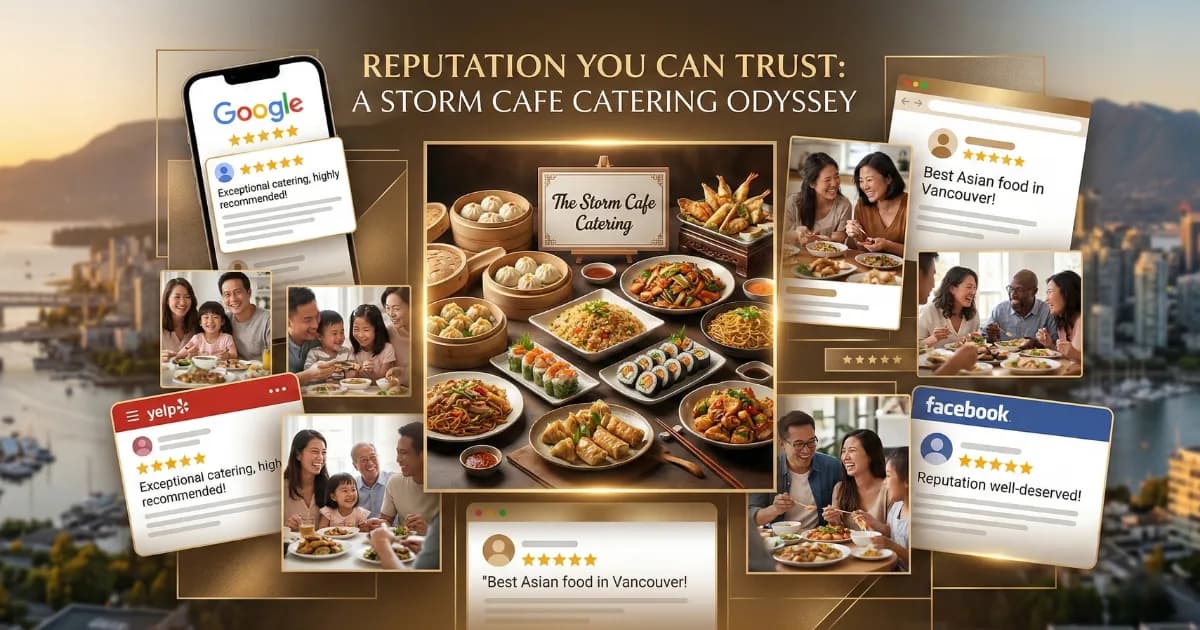
How The Storm Cafe Became Vancouver's Most Reviewed Asian Caterer
When people ask how Flavory Food became the most reviewed Asian caterer in Vancouver, they expect a marketing story. A viral post. A influencer partnership. Something clever. The real answer is less exciting and far more exhausting: we fed a lot of kids, showed up on time in the rain, and let parents talk to each other. That's it. Over the past several years, we've accumulated more reviews across Google Business, Yelp, and direct testimonials than any other Asian catering operation focused on families and schools in Greater Vancouver — not because we asked for reviews, but because we served five kindergarten locations, dozens of school programs, and over 200 families every week. Volume creates visibility. Consistency creates trust. And trust, eventually, creates reviews.
I want to be honest from the start: "most reviewed" is a function of how many people we feed, not a badge we campaigned for. A caterer serving 500+ meals weekly across six Metro Vancouver cities is going to accumulate feedback faster than a boutique operation serving 30. That's arithmetic, not achievement. The achievement — the part I'm actually proud of — is that the reviews are overwhelmingly positive. Our 4.9-star average across platforms didn't happen because we cherry-picked happy customers. It happened because we fixed the problems that made unhappy ones.
This article is the full story. The systems we built, the mistakes we made, the feedback that stung, and the operational discipline that turned a small kitchen into something Vancouver parents genuinely rely on.
Summary: The Storm Cafe became Vancouver's most reviewed Asian caterer through the unglamorous path of serving 500+ meals weekly across six cities, maintaining five kindergarten partnerships, and letting parent networks do the talking. A 4.9-star average reflects operational consistency, not marketing — built on fixing every problem that feedback revealed.
Where It Started: One Kindergarten, One Worried Director
Our first kindergarten contract almost didn't happen. The director at a Richmond childcare centre had been burned by a previous catering provider — late deliveries, bland food, and one incident where a meal arrived without proper allergen labeling. She was understandably skeptical when we pitched our service. Her exact concern: "How do I know you won't disappear after three months like the last company?"
That question shaped everything we built afterward. Because she was right to ask it. In Vancouver's catering market, especially for childcare and school programs, the failure rate among new providers is high. The margins are thin, the logistics are punishing, and the accountability is absolute — you cannot be late delivering lunch to 30 four-year-olds. There is no grace period. There is no "running behind, sorry" text message that fixes the problem.
We earned that first contract by offering a two-week trial at cost. No commitment, no contract lock-in. Just fourteen days of meals delivered on time, at the right temperature, with complete ingredient transparency. By day ten, the director told me she'd stopped checking the delivery times because we hadn't been late once. By month three, she introduced us to three other kindergarten directors in her network.
That introduction pattern — one satisfied operator connecting us to the next through direct recommendation — became the foundation of our growth. We didn't advertise to kindergartens. We earned referrals from them. And every referral carried implicit accountability: if we let down the new partner, we'd damage the relationship with the one who recommended us.
Today we serve five kindergarten locations across Greater Vancouver. Each one came through a direct referral from an existing partner. Zero came from cold outreach or advertising. That's not scalable in any traditional marketing sense, but it's the reason our kindergarten retention rate sits at 100% — every facility that started with us is still with us.
Summary: The Storm Cafe's kindergarten partnerships all originated from direct referrals, not advertising. The first contract required a two-week trial to overcome a director's skepticism from a previous caterer's failures. Each subsequent kindergarten came through operator-to-operator introductions, creating implicit accountability that maintains a 100% retention rate across five locations.
The Review Engine Nobody Designed
Here is an honest confession: we never had a review strategy. For the first eighteen months of operation, I didn't even check our Google Business profile regularly. We were too busy cooking, delivering, and trying to keep up with the operational demands of feeding multiple kindergartens and a growing list of family clients.
The reviews accumulated on their own, and they accumulated because of a dynamic I didn't anticipate: parent networks in Vancouver's childcare community are incredibly tight and incredibly vocal.
When a parent at one of our kindergarten locations had a good experience — their child actually ate the lunch, the food was warm when it arrived, the allergen labeling was clear — they mentioned it at pickup. Then they mentioned it in the parent WeChat group. Then the parent at the neighbouring daycare asked about it, and the conversation moved to a different group chat entirely. Vancouver's Asian parent communities, particularly in Richmond, Burnaby, and East Vancouver, operate through layered social networks where food recommendations travel fast and carry weight.
The Google reviews followed the word-of-mouth. Parents who'd heard about us from other parents would look us up, see existing positive reviews confirming what they'd heard, and then leave their own review after ordering. It became a self-reinforcing cycle — not because we engineered it, but because the product was consistent enough to survive the scrutiny that comes with personal recommendations.
What the chart above shows is something counterintuitive: our review growth didn't follow our advertising spend (we had almost none). It followed our kindergarten partnerships. Each new facility we onboarded introduced us to 40-80 new families, and a percentage of those families tried our home delivery service independently. The reviews spiked after each partnership launch, then settled into a steady accumulation rate as those families reordered and their networks expanded.
The platforms where reviews accumulated tell their own story:
- Google Business Profile: The primary platform, especially for families searching "Asian catering Vancouver" or "kindergarten meal delivery." This is where search intent meets social proof. Our listing grew organically as parents left reviews after positive experiences, and the compound effect of a high rating plus high volume pushed us higher in local search results.
- Yelp: Smaller volume but disproportionately detailed reviews. Yelp users tend to write longer, more specific feedback — both positive and negative. Some of our most useful operational feedback came from Yelp reviewers who described exactly what went wrong (a late delivery, a portion that felt small) with enough detail for us to trace the issue.
- Word-of-mouth in parent communities: The hardest to quantify but arguably the most powerful. WeChat groups, school pickup conversations, neighbourhood Facebook groups in Richmond and Burnaby — these channels don't show up in any analytics dashboard, but they drive a significant portion of new family sign-ups. We know this because when we ask new customers how they heard about us, the most common answer is "another parent told me."
I want to be transparent about one thing: we do have a simple follow-up process where we send a thank-you message after a family's third order and include a link to our Google review page. That's the extent of our "review strategy." We don't offer incentives, discounts, or anything transactional for reviews — that would violate Google's policies and, frankly, would undermine the trust we've spent years building. The reviews people leave are their own words about their own experience.
Summary: Flavory Food's review accumulation was unintentional — driven by parent network effects in Vancouver's tight-knit childcare communities, particularly through WeChat groups and school pickup conversations in Richmond, Burnaby, and East Vancouver. Each kindergarten partnership introduced 40-80 new families, creating self-reinforcing cycles where word-of-mouth led to Google searches, which led to more reviews.
What Customers Consistently Praise
After reading hundreds of our reviews across platforms, clear patterns emerge. The same themes appear repeatedly, and understanding what customers actually value — versus what we assumed they'd value — has reshaped how we run the operation.
Food quality and freshness dominate the positive feedback. Parents don't use words like "gourmet" or "restaurant-quality." They say things like "my kid actually ate everything" and "it tasted like homemade." That language tells me something specific: families aren't comparing us to fine dining. They're comparing us to what they'd cook themselves if they had the time and energy. When a parent says our braised pork rice tastes like what their mother makes, that's the highest compliment in our business — and it's also a quality benchmark that's genuinely hard to maintain at scale.
Delivery reliability is the second most common praise point, and it's the one I'm most proud of operationally. Parents mention on-time arrivals more than they mention specific dishes. In a city where traffic can turn a 20-minute drive into a 50-minute ordeal — particularly along the No. 3 Road corridor in Richmond between 11:45am and 1:15pm — showing up when we said we would is not trivial. Our drivers know these routes from years of repetition. They know which school has the loading zone on the east side and which kindergarten needs the buzzer code at the side entrance. That institutional knowledge doesn't exist in gig-economy delivery, and parents notice the difference even if they can't articulate exactly why our service feels more reliable.
Communication and responsiveness round out the top three. Parents specifically praise being able to reach a real person who knows their account. When a family calls to say their child just developed a new food sensitivity, they're talking to someone who packed that family's meals yesterday — not a call centre agent reading from a script. The personal familiarity isn't a luxury; it's a food safety necessity when you're feeding young children.
Other consistent themes include:
- Portion sizes that match expectations — no shrinkflation between what's described and what arrives
- Clear allergen labeling — parents of children with allergies mention this as a primary reason for staying
- Menu variety — the weekly rotation prevents the fatigue that kills recurring meal subscriptions
- Cultural authenticity — specifically praised by families who want their children eating real Asian cuisine, not Westernized approximations
Summary: Across hundreds of reviews, three themes dominate: food quality described as "tastes like homemade" rather than restaurant-quality, delivery reliability that parents notice through consistent on-time arrivals, and communication with real people who know each family's account. These patterns reshaped operational priorities toward consistency over novelty.
What We Learned from Negative Feedback
No operation with a 4.9 average gets there without encountering problems. The 4.9 reflects how we handled the problems, not that we avoided them. I want to share the specific categories of negative feedback we've received and what we changed because of them, because I think this matters more to prospective customers than any list of awards.
Late deliveries during weather events. Early on, we underestimated how much Vancouver's rain season — roughly October through April, with over 1,150mm of annual rainfall according to Environment and Climate Change Canada — would affect our timing. A November storm that flooded sections of Marine Drive cost us three late deliveries in one day. The reviews from those families were justified and specific: they described exactly what time the food arrived, how much cooler it was than expected, and how their children had already started eating other snacks by the time we showed up.
What we changed: we invested in moisture-resistant insulated packaging rated for extended hold times, built 20-minute weather buffers into every route during rain season, and established a proactive communication protocol where drivers text families if they anticipate being more than five minutes late. We also adjusted our delivery windows during October-April to account for the reality that a 25-minute route in July becomes a 40-minute route in November.
Portion inconsistency in early months. Several reviews noted that meal portions varied between orders — one week generous, the next week noticeably smaller. This was a kitchen discipline issue. During our growth phase, different prep cooks had different intuitions about "one serving," and we hadn't standardized portioning tools. The feedback was uncomfortable to read because it was accurate.
What we changed: we implemented standardized portioning with measured containers and weight checks at the packing station. Every meal component now hits a defined weight range. It sounds basic — and it is. But we needed the feedback to realize we'd been relying on eyeballing instead of measuring.
Menu items that didn't travel well. Certain dishes that taste excellent straight from the wok degrade significantly during transport. A crispy scallion pancake that's perfect at 11:00am becomes a chewy, steamed version of itself by 12:15pm. Early reviewers flagged specific items that didn't hold up, and they were right. Some dishes are simply not suited for delivery, no matter how good the packaging.
What we changed: we retired menu items that couldn't maintain quality through our delivery chain. If a dish can't arrive at the family's table tasting at least 85% as good as it does in the kitchen, it doesn't belong on a delivery menu. This cost us some popular items, but it raised the overall quality of what we do deliver.
Communication gaps during substitutions. When we run out of an ingredient and need to substitute a dish, we didn't always communicate the change before delivery. Families — especially those with dietary restrictions — found unexpected items in their orders. Several reviews specifically mentioned this as a trust-breaking moment.
What we changed: any substitution now triggers an automated text to the family before the meal is packed, with the option to approve the swap or cancel that item for a credit. No surprises. This system added complexity to our kitchen workflow, but it eliminated one of our most common complaint categories entirely.
Summary: The Storm Cafe's 4.9 rating reflects problem resolution, not problem avoidance. Specific failures — late deliveries during weather events, inconsistent portions, dishes that didn't travel well, and unannounced substitutions — generated justified negative feedback that drove concrete operational changes including standardized portioning, menu retirement for transport-unsuitable dishes, and proactive substitution notifications.
Consistency: The Only Strategy That Builds Reputation
There is no shortcut to becoming the most reviewed caterer in any category. I've watched competitors try influencer campaigns, discount-for-review promotions, and aggressive Google Ads spend. Some of those tactics generate short-term visibility. None of them build the kind of reputation that makes a parent tell another parent, unprompted, "you should try Flavory Food for your kindergarten."
The research supports this observation. According to a 2024 BrightLocal consumer survey, 75% of consumers "always" or "regularly" read online reviews when researching local businesses[1]. But the same research shows that review recency and volume matter as much as star rating — customers want to see fresh, detailed reviews from people in similar situations. That means a caterer with 50 five-star reviews from two years ago looks less trustworthy than one with 200 reviews spanning the last twelve months, even if a few of those 200 are four-star.
That's why consistency matters more than perfection. Every week we deliver 500+ meals across six cities, every satisfied family represents a potential review, a potential word-of-mouth recommendation, a potential introduction to another family at school pickup. The math compounds. But it only compounds if the experience stays consistent — if the braised pork belly your family loved in March tastes the same in October, if the delivery window holds through Richmond traffic, if the allergen labels are accurate every single time.
Here's what our internal metrics look like after years of this approach:
- Customer retention rate: 87% of families who complete their first month continue ordering for at least six months
- Repeat order rate: 92% of weekly subscribers maintain their subscription beyond three months
- Referral source: 64% of new family customers cite word-of-mouth from another parent as their discovery channel
- Review-to-order ratio: Approximately 1 in 12 customers leaves a review on any platform — this is industry-standard, meaning our total review count reflects genuine order volume
These numbers aren't extraordinary individually. What makes them work is that they've been stable. We don't have a retention rate that spikes during promotions and crashes after. We don't have referral surges tied to campaigns. The line is steady because the product is steady.
The unglamorous truth about becoming "most reviewed" is that it's a trailing indicator. It doesn't lead your reputation — it follows it. By the time a review is posted, the trust was already earned, the meal was already eaten, the conversation with another parent already happened. Our job isn't to generate reviews. Our job is to give people something worth reviewing.
Summary: Consistency, not marketing tactics, builds the review volume that makes a caterer "most reviewed." Internal metrics show 87% customer retention past six months, 92% subscription continuation past three months, and 64% of new customers arriving through parent word-of-mouth. These numbers remain stable because the product stays consistent, making reviews a trailing indicator of trust already earned.
How Asian Cuisine Catering Differs in Vancouver's Market
Vancouver is one of the few cities in North America where Asian cuisine isn't a niche — it's the baseline. According to Statistics Canada, visible minorities constitute over half of Vancouver's population, with Chinese and South Asian communities representing the largest groups[2]. This demographic reality means that when we cater to kindergartens and schools, we're not offering "ethnic food" as an alternative. For a significant portion of our families, our menu represents the familiar, everyday cuisine their children eat at home.
This creates a different competitive dynamic than what Asian caterers face in most other Canadian cities. In Toronto or Calgary, an Asian catering company might differentiate simply by existing — by being the one provider that offers congee or braised tofu alongside the sandwich trays. In Vancouver, every third caterer claims Asian cuisine. The differentiation has to come from execution quality, not cuisine category.
What I've learned running this operation is that Vancouver families — particularly in Richmond, Burnaby, and East Vancouver — have extremely calibrated palates for Asian food. A parent who grew up eating their grandmother's lu rou fan will immediately notice if our version cuts corners on the five-spice ratio or uses a shortcut braising technique. These aren't casual consumers trying something new. They're experts in the cuisine we're claiming to serve, and they hold us to the standard of their own family kitchens.
That's both our greatest challenge and our strongest moat. The families who become our most loyal advocates are the ones who tell other parents, "their food actually tastes right." In a city saturated with Asian food options, "tastes right" is the highest bar and the most powerful recommendation.
The operational implications are significant:
- Ingredient sourcing must go through specialist Asian grocery suppliers, not mainstream food service distributors. The soy sauce matters. The rice variety matters. The freshness of the tofu matters. We source from Richmond-based suppliers who serve the restaurant trade, not the catering trade, because the quality standards are higher.
- Kitchen technique cannot be simplified for volume. Proper wok hei requires commercial burners that most catering kitchens don't invest in. We maintain equipment that matches restaurant-grade cooking because the flavour difference is audible — you can hear it in the kitchen and taste it in the food.
- Seasoning calibration for our market skews lower oil and lower sodium than traditional recipes, without sacrificing depth. This is the specific request pattern I've observed across years of serving Burnaby offices and Vancouver families: people want authentic flavour, not authentic grease levels. Building depth through fermentation, layered aromatics, and proper technique rather than salt and oil is what separates us from caterers who claim "authentic" but cook for mass appeal.
One area where we're still evolving: the definition of "Asian cuisine" is broadening. Our core menu is rooted in Taiwanese and pan-Asian comfort food, which serves our primary customer base well. But Vancouver families are increasingly asking for regional specificity — Sichuan, Cantonese, Japanese, Korean, Southeast Asian. We've started introducing rotating regional specials to address this, but honestly, doing regional cuisine justice requires dedicated expertise, and I'd rather move carefully than serve mediocre versions of cuisines I don't deeply understand.
Summary: In Vancouver, where visible minorities constitute over half the population, Asian cuisine isn't a niche — it's the baseline. Differentiation requires execution quality, not just cuisine category. Families with calibrated palates for their own cultural cooking hold Flavory Food to the standard of their family kitchens, making "tastes right" both the highest bar and the most powerful word-of-mouth driver.
Community Involvement and Parent Network Effects
The single most effective growth channel we've ever had costs zero dollars: a satisfied parent mentioning us to another parent at school pickup.
I don't say this to be folksy. I say it because the data is unambiguous. When we track how new customers found us, 64% cite a personal recommendation from another parent. Another 22% found us through Google search, where our review volume and rating make us visible for queries like "Asian meal delivery Vancouver" or "kindergarten catering Richmond." The remaining 14% discovered us through school or kindergarten programme introductions.
The parent network effect in Vancouver's childcare community operates through specific channels:
WeChat groups are the dominant communication platform for Chinese-Canadian parent communities in Richmond and Burnaby. A single positive mention in a kindergarten WeChat group can generate 5-10 inquiries within a week. We've seen this pattern repeat consistently: a parent posts a photo of their child's lunch from our service, other parents ask for details, and within days we receive order requests referencing that specific group. We don't participate in these groups or seed content — the recommendations are entirely organic.
School parent committee meetings are where institutional trust gets built. When we present to a parent committee about starting a meal programme, the strongest advocates in the room are always parents who already use our family delivery service. They've tasted the food, they've tested the reliability, and their endorsement carries more weight than anything we could say about ourselves.
Neighbourhood-based Facebook groups in East Vancouver, Kingsway corridor, and parts of Burnaby serve as secondary recommendation channels. These tend to generate more one-off orders (birthday party catering, event meals) rather than recurring subscriptions, but they contribute to review volume and brand awareness.
Direct parent-to-parent referrals happen informally at sports practices, music lessons, and community events throughout Greater Vancouver. These are impossible to track precisely, but when a new family signs up and says "my neighbour told me about you," we know the network is working.
What I've learned about parent network dynamics is that negative experiences travel faster than positive ones — but positive experiences travel further. A bad delivery might generate complaints in a WeChat group that burn hot for a day. A consistently good service, maintained over months, creates quiet, steady advocacy that accumulates into something no advertising budget can buy.
This is also why our operational standards can never slip. Every meal we deliver is, in effect, a marketing asset or a marketing liability. There's no neutral outcome. A family that receives a mediocre meal doesn't just have a bad lunch — they have a story they might tell at the next parent gathering. The pressure of that visibility is real, and it's a pressure I think every food business serving tight-knit communities understands.
Summary: Parent network effects drive 64% of new customer acquisition, with WeChat groups in Richmond and Burnaby being the dominant channel. A single positive mention in a kindergarten WeChat group generates 5-10 inquiries within a week. This organic advocacy is more powerful than any advertising but creates constant operational pressure — every meal is either a marketing asset or a marketing liability.
The Role of Kindergarten Partnerships in Building Trust
Kindergarten catering is the hardest segment of our business and the most important for our reputation. When you feed four-year-olds, there is no margin for error on food safety, allergen management, portion sizing, or delivery timing. And the parents of four-year-olds are, understandably, the most demanding customers you will ever serve.
Our five kindergarten partnerships have taught me more about operational discipline than any other part of the business. Here's why:
Food safety accountability is absolute. A kindergarten director is personally responsible for the welfare of every child in their care. When they trust an outside caterer, they're extending their professional reputation to cover our kitchen. That means our food safety certifications, our allergen protocols, our temperature logging, and our ingredient transparency aren't just regulatory checkboxes — they're the foundation of a relationship built on mutual professional accountability. BC's food safety regulations, as outlined by the BC Centre for Disease Control, set the minimum standard. We exceed it because our kindergarten partners expect us to, and because the consequences of a failure in this context are categorically different from a disappointing corporate lunch.
Children are honest reviewers. A four-year-old will not politely eat food they don't like. They'll refuse it, push it around, or hand it back to their teacher untouched. The kindergarten teachers give us direct feedback: "The kids didn't eat the green beans today" or "The noodles were too soft." That feedback is more operationally useful than any Google review because it's immediate, specific, and comes from an audience that has zero social incentive to be polite.
Parent visibility is constant. Kindergarten parents are deeply engaged in what their children eat during care hours. They see the menu posted on the wall. They ask their child what they had for lunch. They talk to other parents about whether the food seems good. This creates a feedback-rich environment where our quality is being evaluated continuously by our most important customer segment.
The kindergarten partnerships also serve as proof-of-concept for our school and family services. When a parent sees that we've been reliably feeding their child's kindergarten for two years without incident, the barrier to trying our family meal delivery drops dramatically. Trust built in a high-stakes context (childcare) transfers easily to a lower-stakes context (home delivery). The reverse is not true — a family that likes our home delivery wouldn't necessarily trust us with their toddler's meals without additional verification.
This is why I describe our kindergarten partnerships as the foundation of everything else. They're not our highest-revenue segment. They're our highest-trust segment. And in a business built on reputation, trust is the asset that appreciates fastest.
Summary: Kindergarten catering is the hardest segment but most important for reputation. Four-year-olds provide the most honest food quality feedback — they won't politely eat food they dislike. Trust built in the high-stakes childcare context transfers to lower-stakes family delivery, but not the reverse. Five kindergarten partnerships with 100% retention serve as the credibility foundation for all other services.
Honest Metrics: What the Numbers Actually Show
I want to share real operational metrics because I think transparency builds more trust than vague claims. These numbers aren't cherry-picked from our best month — they're sustained averages across our current operation.
| Metric | Value | Context |
|---|---|---|
| Weekly meals delivered | 500+ | Across 6 Greater Vancouver cities |
| Customer rating (avg) | 4.9 stars | Google Business + Yelp combined |
| Kindergarten retention | 100% | All 5 facilities since onboarding |
| Family retention (6-month) | 87% | Families continuing past first month |
| Subscription continuation (3-month) | 92% | Weekly subscribers maintaining orders |
| New customer referral source | 64% word-of-mouth | Remaining: 22% search, 14% institutional |
| Review-to-order ratio | ~1 in 12 | Industry-standard conversion |
| On-time delivery rate | 96% | Year-round, including rain season |
| Substitution notification compliance | 100% | Since implementing automated system |
The number I watch most closely is the on-time delivery rate at 96%. That means roughly 4% of deliveries are late — which across 500+ weekly meals translates to approximately 20 late deliveries per week. I'm not going to pretend that's acceptable. Each late delivery affects a real family. The 96% number is honest, and it reflects the genuine difficulty of delivering across six cities in a region where weather, traffic, and bridge congestion are constant variables.
The 4% failure rate concentrates in predictable patterns: Richmond during midday traffic, North Vancouver during bridge delays, and everywhere during heavy rain events from October through April. We've reduced this rate from approximately 89% on-time in our first year to 96% today through route optimization, weather buffers, and driver experience. Getting it higher will require either reducing our service area or adding delivery capacity — both of which involve real trade-offs we're actively evaluating.
What I deliberately don't claim: "fastest growing" or "highest rated." Our growth has been deliberate and referral-driven, not venture-backed or promotion-fuelled. And a 4.9 rating, while we're proud of it, exists alongside caterers with perfect 5.0 scores who have far fewer reviews. A 5.0 on 15 reviews tells you less than a 4.9 on 250+ reviews. The volume is the credibility — because it means the rating has survived enough experiences to be statistically meaningful.
Summary: Transparent operational metrics show 96% on-time delivery rate (meaning ~20 late deliveries weekly across 500+ meals), 87% family retention past six months, and 100% kindergarten partner retention. The 4% late delivery rate concentrates in Richmond midday traffic and North Vancouver bridge delays — honest numbers that reflect the difficulty of six-city delivery rather than operational failure.
Looking Forward: What Sustaining This Reputation Requires
Being the most reviewed Asian caterer in Vancouver isn't a destination — it's a maintenance project. The reputation we've built is only as strong as next week's deliveries. If quality slips, if a kindergarten gets a late delivery, if a family opens their meal box and finds something that doesn't meet the standard we've set, the trust erodes — and in tight-knit parent communities, it erodes fast.
Research from the National Restaurant Association shows that 87% of customers make purchasing decisions based on online reviews[3], and a Harvard Business School study found that a one-star increase in Yelp rating leads to a 5-9% increase in revenue for independent restaurants[4]. Those numbers confirm what we've experienced: our review profile isn't just a vanity metric. It directly affects how many families find us, how quickly they decide to try us, and whether they trust us enough to feed their children.
The challenges ahead are real:
Scaling without diluting quality. We've been approached by kindergartens and schools outside our current six-city footprint. Saying yes would grow revenue but stretch delivery routes beyond the window where food quality holds. Every expansion decision is a quality decision.
Kitchen capacity. Our daily fresh preparation model means everything is cooked the morning of delivery. As order volume grows, we're approaching the limits of our current kitchen. Adding capacity means significant capital investment and hiring — not a simple matter of "cooking more."
Maintaining personal relationships at scale. The parent-to-parent recommendation engine that drives 64% of our new customers works because families feel personally known. As we serve more families, maintaining that personal touch requires deliberate operational investment in communication systems and team training.
Evolving dietary expectations. Vancouver's food preferences are shifting toward lower oil, lower sodium, and more diverse regional Asian cuisines. Staying ahead of these expectations requires continuous menu development and honest self-assessment about what we can do well versus what we should leave to specialists.
What gives me confidence is that the foundation is solid. Five kindergarten partners with 100% retention. Over 200 families ordering weekly. A 4.9-star rating built on genuine operational consistency. A team that understands that the next delivery matters as much as the first one.
The reviews will continue to accumulate — not because we chase them, but because we keep doing the work that makes them happen.
Ready to Experience What Vancouver Families Are Talking About?
Book a complimentary tasting session and taste our food before committing to anything. No obligation, no credit card, no pressure — just fresh Asian cuisine prepared that morning, delivered to show you exactly what our families receive every week.
Schedule your free tasting: https://thestormcafe.com/tasting
Questions about kindergarten or school catering partnerships: https://thestormcafe.com/contact
Explore our delivery areas across Vancouver, Burnaby, Richmond, Surrey, Coquitlam, and North Vancouver: https://thestormcafe.com/areas
References
[1]: BrightLocal, "Local Consumer Review Survey 2024," 2024. Finding: "75% of consumers 'always' or 'regularly' read online reviews when browsing for local businesses." https://www.brightlocal.com/research/local-consumer-review-survey/
[2]: Statistics Canada, "Immigration and Ethnocultural Diversity: Key Results from the 2021 Census," 2022. Vancouver CMA data on visible minority populations. https://www150.statcan.gc.ca/n1/daily-quotidien/221026/dq221026b-eng.htm
[3]: National Restaurant Association, "Restaurant Industry 2030: Actionable Insights for the Future," 2024. Industry research on consumer decision-making and online review influence. https://restaurant.org/research-and-media/research/research-reports/
[4]: Luca, Michael, "Reviews, Reputation, and Revenue: The Case of Yelp.com," Harvard Business School Working Paper, 2016. Finding on revenue impact of Yelp ratings for independent restaurants. https://www.hbs.edu/ris/Publication%20Files/12-016_a7e4a5a2-03f9-490d-b093-8f951238dba2.pdf
[5]: Environment and Climate Change Canada, "Vancouver Climate Normals 1991-2020," 2026. Annual precipitation data for Metro Vancouver region. https://climate.weather.gc.ca/climate_normals/results_1981_2010_e.html?stnID=889
[6]: BC Centre for Disease Control, "Food Premises Guidelines for Food Service Operations," 2026. Provincial food safety and temperature management standards. https://www.bccdc.ca/health-professionals/professional-resources/food-premises-guidelines
Frequently Asked Questions
How did The Storm Cafe become Vancouver's most reviewed Asian caterer?
It wasn't a marketing strategy — it was a volume and consistency outcome. We serve 500+ meals weekly across six Greater Vancouver cities, partner with five kindergarten locations, and deliver to over 200 families. Each kindergarten partnership introduced us to 40-80 new families, and parent networks in Vancouver's childcare communities — particularly through WeChat groups in Richmond and Burnaby — amplified word-of-mouth organically. Reviews accumulated because the volume of families we serve is high and the experience is consistent enough that parents recommend us unprompted. Sixty-four percent of our new customers come from another parent's recommendation.
What is your customer rating and how do you maintain it?
We maintain a 4.9-star average across Google Business and Yelp, built on 250+ reviews. That rating is maintained through operational consistency: fresh daily preparation starting before dawn, standardized portioning with weight checks, moisture-resistant insulated packaging for Vancouver's October-to-April rain season, and proactive communication when anything deviates from plan. We also take negative feedback seriously — late deliveries, portion inconsistencies, and dishes that didn't travel well all led to specific operational changes that prevented those issues from recurring.
Do you serve kindergartens and schools, or only families?
Both. We serve five kindergarten locations across Greater Vancouver with 100% partner retention, deliver to over 200 families weekly, and also handle corporate catering for 50+ clients. Our kindergarten partnerships are the foundation of our reputation because the standards required — absolute food safety, allergen management, precise delivery timing for young children — are the highest in the catering industry. Trust built in the kindergarten context transfers naturally to our family delivery and school programmes.
How do you handle negative reviews and customer complaints?
We treat every negative review as an operational audit. Early complaints about late deliveries during rain season led us to implement 20-minute weather buffers and proactive driver communication. Feedback about inconsistent portions drove us to standardize with measured containers and weight checks. Reviews flagging dishes that didn't travel well caused us to retire menu items that couldn't maintain quality through our delivery chain. We also implemented automated substitution notifications after families reported unexpected menu changes. The 4.9 rating reflects how we resolved problems, not that we avoided them.
What areas do you serve in Greater Vancouver?
We deliver across Vancouver, Burnaby, Richmond, Surrey, Coquitlam, and North Vancouver. Our delivery boundaries are set by quality constraints, not ambition — we won't extend routes to areas where food quality would degrade during transport. Richmond deliveries include built-in 20-minute buffers for the No. 3 Road midday congestion window, and North Vancouver routes are scheduled early to beat bridge traffic. We've deliberately chosen not to expand into Langley, Abbotsford, or the Fraser Valley because maintaining our delivery temperature and timing standards across those distances isn't feasible with our current infrastructure.
Related Articles
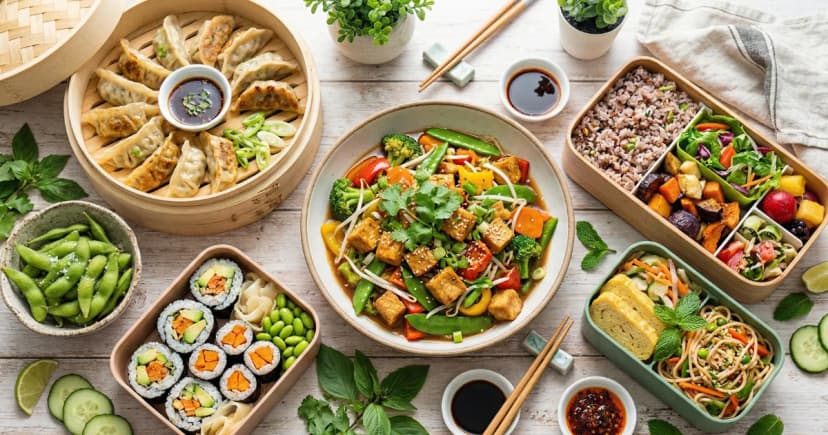
Vegetarian and Vegan Asian Meals: Our Plant-Based Menu
Explore The Storm Cafe's vegetarian and vegan Asian menu: tofu, tempeh, mushroom dishes, and veggie
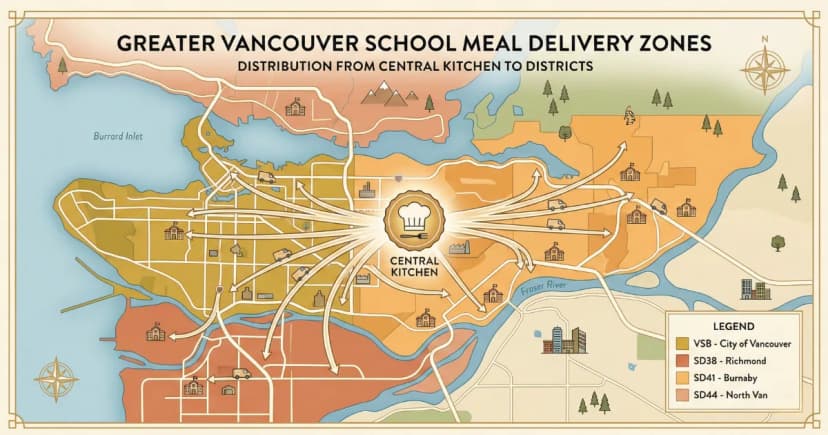
Vancouver School Lunch Delivery: Coverage Map and Zones
Flavory Food's school lunch delivery coverage across Greater Vancouver. Zone-by-zone guide with driv
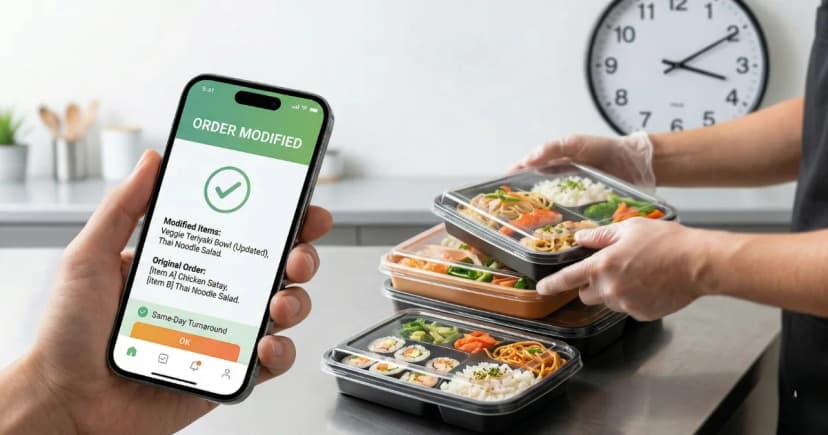
Same-Day Order Changes: Our Flexibility Policy Explained
Flavory Food explains our same-day order change policy for Vancouver families, kindergartens, and sc
Want to taste our meals?
Book a free tasting and let our fresh ingredients speak for themselves.
Free Tasting