Behind the Kitchen: How We Prep 500 Meals Every Morning
Discover how Flavory Food prepares 500+ fresh meals daily in Vancouver. Inside look at our commercial kitchen workflow, team structure, and quality control processes.
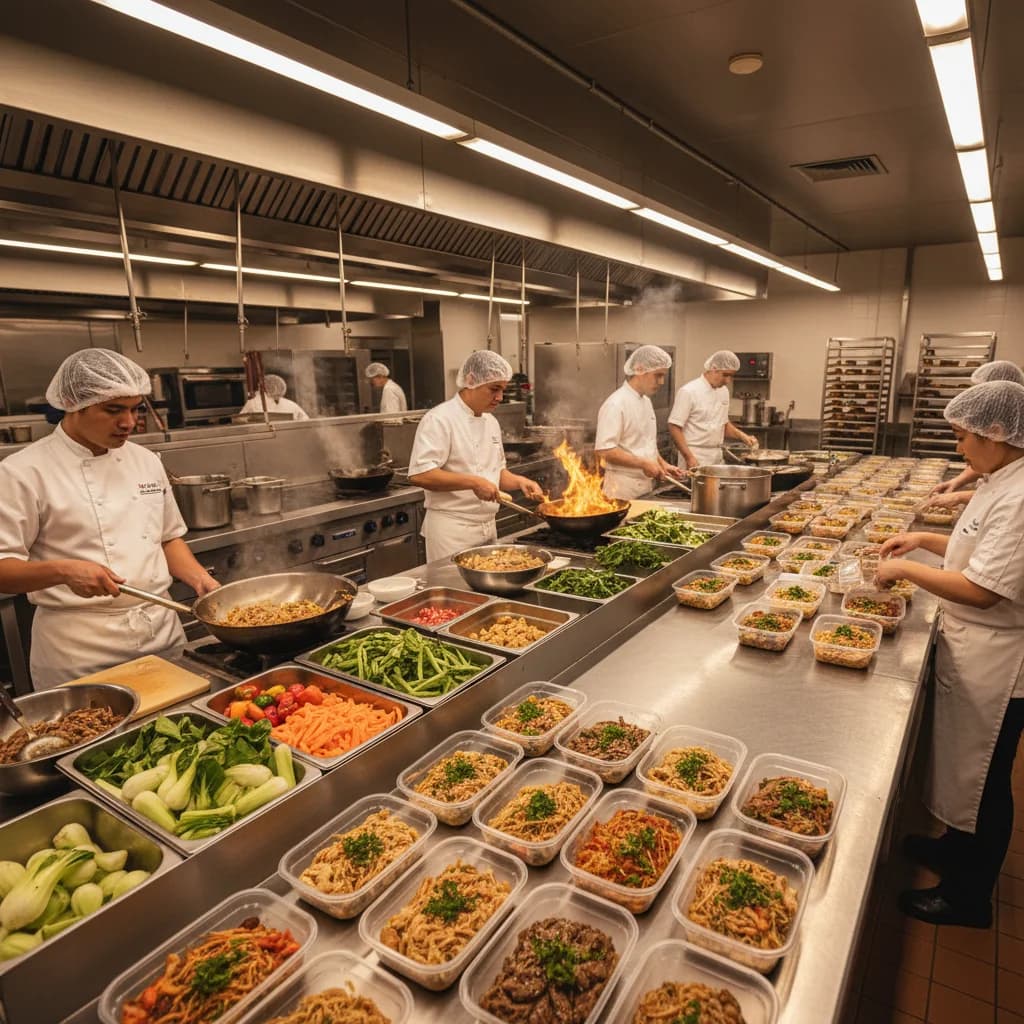
Behind the Kitchen: How We Prep 500 Meals Every Morning
Every morning before sunrise, our kitchen is already loud. Extractors running, rice cookers cycling, protein stations firing — all timed so the first delivery vehicles roll out before the region's traffic windows close on us. According to Fortune Business Insights, the global prepared meals market reached USD 190.71 billion in 2025, driven by growing demand for convenient, fresh meal solutions[1]. We've built our entire operation around one unforgiving reality: 500+ authentic Asian meals need to leave this kitchen every single day, hit temperature targets on arrival, and satisfy the specific tastes of corporate clients from Richmond to Downtown Vancouver.
Here's how we actually make that happen, broken into the steps and systems that keep the operation from falling apart:
- Production planning locks in 48 hours before cook day. For any order above 50 meals, the menu is confirmed two full days out. No exceptions. This gives our purchasing lead time to source from local suppliers and lets prep cooks stage mise en place the afternoon before.
- The cook schedule is reverse-engineered from delivery windows. We know from years of running this route that Richmond to Downtown during peak hours eats 50 minutes minimum. A Burnaby office requesting 2:00–3:00 PM delivery — which most of them do, specifically to dodge the lunch rush — means that batch finishes plating by 1:15 PM at the latest. Every station works backward from the truck departure time, not forward from when the stoves turn on.
- Seasoning profiles are calibrated for our actual clients. Burnaby's office market consistently asks for lower oil, lower sodium. We learned this through hundreds of feedback loops, not guesswork. Sauces are pre-portioned to spec, and line cooks don't freestyle.
- Temperature control is non-negotiable, especially October through April. Vancouver's rain season destroys food quality if you're not prepared. We've tested four different insulated delivery bags and settled on moisture-resistant thermal units that hold meals above 65°C for 90 minutes in wet conditions. That's not a marketing number — we probe-tested those bags in actual November downpours on actual delivery runs.
- Cross-training keeps the line resilient. Every cook can work at least two stations. When someone calls in sick — and in a 500-meal kitchen, that's a when, not an if — production doesn't stall.
- Quality checkpoints are built into three stages: prep, plating, and pack-out. Each stage has a designated lead who signs off. Food safety protocols here go beyond what's required by Vancouver Coastal Health's food safety certification requirements, because at this volume, a single contamination event doesn't just cost you a client. It costs you the business.
The margin for error at 500 meals a day is essentially zero. Every system we run — the 48-hour confirmations, the reverse-scheduled cook times, the rain-tested thermal bags, the Richmond traffic buffers — exists because we got burned by not having it. This isn't theory. It's what actually works when you're feeding Vancouver's offices six days a week.
Summary: Start 4:00 AM for 10:30 AM delivery window. Run three parallel cooking stations simultaneously. Follow mandatory quality checkpoints: visual inspection, temperature verification, taste testing. Use 12-person team with defined roles. Deploy commercial-grade woks and batch cooking equipment. Maintain ingredient standardization across rotating 30+ dish menu. Build 20-minute buffer time for Richmond traffic delays during lunch rush.
The Pre-Dawn Start: 4:00 AM – 5:30 AM
Flavory Food's kitchen team arrives at 4:00 AM to begin the multi-stage prep process that ensures all 500+ meals are ready for delivery by 10:30 AM.
After running high-volume kitchen operations across Greater Vancouver for years, I can tell you this 6.5-hour window between 4:00 AM and 10:30 AM is where everything is won or lost. There's zero room for improvisation — every minute has a job. Here's exactly how the morning breaks down.
Ingredient Inspection and Inventory Check
The shift supervisor kicks off the day with a full inventory audit before anyone fires up a burner. This is non-negotiable, especially when you're sourcing fresh produce for authentic Asian dishes where ingredient quality makes or breaks the final plate.
Follow these steps in exact order:
- Verify overnight supplier deliveries — Cross-check every item (proteins, vegetables, sauces, packaging materials) against the purchase orders. Missing items at 4:00 AM means scrambling to find alternatives before prep begins, and in Metro Vancouver, your backup supplier options at that hour are limited.
- Inspect fresh produce quality — Physically examine all fruits, vegetables, and herbs. Reject anything below standard immediately. Don't set it aside "to decide later" — that's how subpar ingredients end up in 500 meals.
- Record refrigeration temperature logs — Check and document temps for every fridge and walk-in cooler. This is your HACCP compliance backbone, and it's required under BC Centre for Disease Control food premises guidelines. I've seen operators treat this as a formality until an inspector shows up. Do it properly every single morning.
Kitchen Station Setup
Six primary cooking stations need to be activated simultaneously. Each one handles a distinct function, and the flow between them is what makes a 500+ meal operation possible by 10:30 AM.
- Protein station — marinating and cooking meats
- Vegetable prep station — washing, cutting, and blanching
- Rice and grain station — bulk cooking
- Sauce and seasoning station — preparing signature flavors
- Assembly line station — plating
- Packaging and labeling station — final quality checks
Critical setup details:
- Confirm all equipment is operational before prep starts. A dead rice cooker or a malfunctioning burner discovered at 5:00 AM costs you 30+ minutes you don't have. Run a quick power-on check across every station.
- Ensure each station is stocked with its specific tools, containers, and ingredients. Cooks walking across the kitchen to grab supplies mid-service is a throughput killer at this volume.
- Verify all equipment meets NSF/ANSI 4-2025 standards for sanitation and efficiency[3]. This isn't just about passing inspections — properly rated commercial-grade equipment holds temperatures more reliably, which matters enormously when those meals are heading into our tested insulated bags for delivery across Vancouver, Richmond, and Burnaby in unpredictable weather.
Summary: Begin with complete inventory audit before firing any equipment. Verify overnight deliveries against purchase orders. Check protein temperatures and produce quality standards. Set up all cooking stations with tools, seasonings, and prep containers. Complete ingredient portioning and mise en place setup. Confirm daily production targets against client orders. This 90-minute window establishes the foundation for successful 500+ meal output.
Peak Production: 5:30 AM – 9:00 AM
The core meal preparation phase at Flavory Food runs from 5:30 AM to 9:00 AM, with all cooking stations operating simultaneously to maximize output while maintaining quality.
Parallel Cooking Workflow
Running three cooking tracks at once is the only way to hit a 9:00 AM assembly deadline for 500+ meals — and after years of dialing in commercial kitchen timing across Vancouver operations, I can tell you the margins here are razor-thin. Every station has a hard start time and a hard finish time. Miss one, and the whole assembly line backs up. Industry best practices for restaurant kitchen efficiency confirm that parallel processing is the single biggest lever for reducing total prep time[4]. Here's how Flavory Food breaks it down:
gantt
    title Parallel Cooking Workflow - 500+ Meal Production Timeline
    dateFormat HH:mm
    axisFormat %H:%M

    section Protein Track
    Fire up woks/grills           :milestone, m1, 05:30, 0m
    Cook proteins (batches)       :active, p1, 05:30, 90m
    Temperature checks            :p2, 06:30, 30m
    Stage in holding pans         :milestone, m2, 07:00, 0m

    section Vegetable Track
    Wash & sort vegetables        :active, v1, 05:45, 30m
    Process & cut vegetables      :v2, 06:15, 30m
    Blanch to 80% done           :v3, 06:45, 15m
    Ice bath & portion           :milestone, m3, 07:00, 0m

    section Grain Track
    Load rice cookers            :milestone, m4, 05:30, 0m
    Cook grains (staggered)      :active, g1, 05:30, 120m
    Fluff & portion             :milestone, m5, 07:30, 0m

    section Assembly Line
    Assembly begins             :milestone, m6, 07:30, 0m
    Full production assembly    :crit, a1, 07:30, 90m
    Packaging complete          :milestone, m7, 09:00, 0m
Protein Preparation (90 minutes — start by 5:30 AM, done by 7:00 AM)
- Fire up three industrial woks and two large grills at 5:30 AM sharp — no exceptions.
- Cook marinated proteins (chicken, beef, pork, tofu) in batches of 50–75 portions per round, following the day's menu rotation.
- Monitor internal temperatures on every batch with probe thermometers to ensure food safety compliance. Chicken hits 74°C internal, beef and pork hit their respective safe thresholds — document each reading.
- Stage finished proteins in holding pans, covered and labeled, ready for the assembly line by 7:00 AM.
One thing I'll flag from running Burnaby office catering: those clients consistently prefer lower oil and lower salt profiles. If your menu rotation includes dishes headed to that market, your wok team needs to know before they start cooking — adjusting seasoning after the fact doesn't work at this scale.
Vegetable Processing (75 minutes — start by 5:45 AM, done by 7:00 AM)
- Begin washing and sorting 200+ pounds of fresh vegetables at 5:45 AM. Prioritize leafy greens (bok choy) first — they wilt fastest.
- Run hearty vegetables (carrots, broccoli, peppers) through industrial food processors and mandolins for uniform cuts. Use commercial blenders for any puréed components.
- Blanch pre-cut vegetables at the blanching station to optimal texture — firm enough to hold through transport and final assembly, cooked enough to retain nutrients.
- Ice-bath blanched vegetables immediately to stop carryover cooking.
- Drain, portion into prep containers, and stage for the assembly line by 7:00 AM.
The blanching step matters more than people think, especially for Vancouver catering. Your meals are going into delivery vehicles, potentially sitting in insulated bags for up to 90 minutes depending on route and traffic. Vegetables that are fully cooked at the kitchen will be mush by the time they reach a client in Richmond or Downtown. Blanch to about 80% done — they'll carry over perfectly.
Bulk Grain Cooking (120 minutes — start by 5:30 AM, done by 7:30 AM)
- Load commercial rice cookers with jasmine rice, fried rice bases, and noodle components in 30-pound batches at 5:30 AM.
- Stagger start times if your cookers share circuits — tripping a breaker at 6:00 AM is a disaster I've seen happen more than once.
- Time grain completion to land at exactly 7:30 AM, when assembly begins. Grains that sit too long get gummy; grains that finish late hold up every station downstream.
- Fluff and portion immediately into holding containers for the base layer station.
This is the longest track at 120 minutes, which is why it starts at the same time as proteins. The margin for error is zero — if grains aren't ready at 7:30, your entire assembly schedule slides, and that cascades directly into your delivery windows.
The Assembly Line: Where It All Comes Together
From 7:30 AM to 9:00 AM, Flavory Food's assembly line transforms prepped ingredients into 500+ complete meals, with each team member responsible for specific components to maintain consistency and speed.
The assembly line operates in a strict linear flow designed to minimize cross-contamination risks while maximizing throughput. Every station has one job. Nobody freelances.
- Base Layer Station: Portion rice or noodles into containers using standardized scoops — consistent weight every time.
- Protein Station: Add pre-weighed protein portions. Match protein type to the correct container and menu label.
- Vegetable Station: Arrange fresh blanched vegetables with attention to visual appeal — clients eat with their eyes first, especially corporate accounts.
- Sauce Station: Measure and apply signature sauces using portion cups or squeeze bottles. No eyeballing.
- Garnish Station: Add final touches (sesame seeds, green onion, chili flakes per menu spec) and perform a quality inspection on every single meal — check protein amount, vegetable placement, sauce coverage, container cleanliness.
- Packaging Station: Seal containers, apply labels with complete delivery information (client name, address, dietary notes, delivery time window), and stage by route.
Systematic workflow design like this reduces bottlenecks and improves throughput in bulk food production operations[5]. With two team members staffing each station, Flavory Food's linear assembly process completes 70–85 meals per hour.
From a delivery logistics standpoint, that 9:00 AM finish time is non-negotiable. If you're running meals to Richmond during the midday rush — say, 11:45 AM to 1:15 PM — traffic congestion is brutal, and you need to build in at least a 20-minute buffer on top of your normal transit time. A Richmond-to-Downtown route that takes 30 minutes off-peak will eat 50 minutes during the lunch window. Meals that leave the kitchen late don't just arrive late — they arrive cold, and in Vancouver's rainy season from October through April, that problem compounds fast. We've tested four different insulated delivery bags specifically to keep food above 65°C for 90 minutes in wet, cold conditions. That kind of thermal performance is what separates reliable catering operations from ones that lose accounts after one bad delivery.
Summary: Operate three cooking stations simultaneously: proteins, vegetables, starches. Maintain strict timing to complete all cooking by 9:00 AM assembly deadline. Use industrial woks with high-BTU burners for authentic stir-frying at volume. Coordinate between line cooks to prevent bottlenecks. Monitor cooking temperatures continuously for food safety compliance. This 3.5-hour window requires precise execution to deliver 500+ meals on schedule.
Quality Control Checkpoints
Every meal prepared at Flavory Food passes through three mandatory quality control checkpoints before packaging, ensuring the 4.9-star customer rating the company maintains.
After catering hundreds of events across Metro Vancouver — from downtown office lunches to large-format Richmond banquets — I can tell you that quality control isn't something you do when you have time. It's something you build into every single batch, every single day. These three checkpoints are non-negotiable, and every meal clears all three before it gets anywhere near a delivery bag.
Visual Inspection Standards
Every assembled meal gets a visual review before it moves to packaging. Here's exactly what to check, in order:
- Portion sizes — Confirm each container matches the customer's specifications. Corporate offices in Burnaby, for example, consistently request lighter, lower-oil, lower-salt meals. If the spec says 150g of protein, weigh it. Don't eyeball it.
- Color balance and ingredient variety — Look at the meal as a whole. If it's all beige, something's wrong. Clients eat with their eyes first, especially at catered events where your food represents someone's brand.
- Absence of foreign materials — Check for stray ties, glove fragments, packaging bits, hair. One incident can undo years of reputation.
- Container integrity and seal quality — Press the lid, inspect the seal. This matters even more during Vancouver's rainy season (October through April). A weak seal plus a bumpy delivery route equals a ruined meal and a lost client.
Assign one person per shift to own this checkpoint. Don't let it become "everyone's job," because that means it's nobody's job.
Temperature Verification
Hot meals must reach an internal temperature of 165°F (74°C) before packaging. Cold items must stay below 41°F (5°C). These thresholds follow FDA Food Code guidelines[6] — and they're exactly what Vancouver Coastal Health auditors will check.
Here's the verification process, step by step:
- Use calibrated digital thermometers only. We tested four different probe models over the years, and cheap ones drift after a few weeks. Calibrate weekly at minimum.
- Check temperatures at random intervals across each batch — not just the first and last container. Pull from the middle of the line too.
- Log every reading immediately — time, temperature, batch number, staff initials. Keep these logs organized and accessible. When a health department audit happens, you don't want to be digging through a binder.
- Flag any reading outside range instantly. Don't re-check and hope. Pull the item, reheat or rechill, and verify again before it re-enters the line.
This step is especially critical for us because of delivery windows. A hot meal leaving our kitchen headed for a downtown Vancouver office during peak hours could sit in transit for 50 minutes from Richmond. We've tested and invested in moisture-resistant insulated bags that keep food above 65°C for 90 minutes, even in heavy rain — but that only works if the food leaves the kitchen at the right temperature in the first place.
Taste Testing Protocol
One meal from every batch of 50 gets pulled for a taste test by the kitchen manager. No exceptions, no shortcuts. Here's what to evaluate:
- Seasoning consistency — Compare directly against the recipe spec. Palate fatigue is real in a busy kitchen, so rinse and reset between tests.
- Cooking texture for proteins and vegetables — Chicken should not be rubbery. Broccoli should not be mush. If textures are off, the batch needs correction before anything ships.
- Sauce balance and flavor profile — Too salty, too sweet, too acidic? Catch it here. Metro Vancouver's corporate clients are particular about this, and repeat orders depend on consistency.
- Overall dish presentation — Even after the visual inspection checkpoint, look at this meal as a customer would when they open the lid at their desk. Does it look like something worth ordering again?
Document any issues found during taste testing and tie them back to specific prep stations or line cooks. Patterns show up fast when you track them, and that's how you fix problems at the root instead of catching them at the end every time.
Summary: Implement three mandatory checkpoints: visual inspection for portion accuracy and presentation, temperature verification using digital thermometers, and taste testing for seasoning consistency. Every meal must pass all three stages before packaging. Document any failures and remake immediately. Maintain 4.9-star rating through consistent application of these standards. Quality control staff separate from assembly team to ensure objectivity.
The Team Behind the Meals
Flavory Food's morning kitchen operation requires a coordinated team of 12 staff members, each specializing in specific stations to maintain the efficiency needed to prepare 500+ meals.
Running a kitchen that pushes out 500+ meals before the lunch rush is no small feat — I've seen operations half this size fall apart without clear roles. Here's how Flavory Food structures their 12-person team so every station knows exactly what to do and when.
| Role | Responsibilities | Team Size |
|---|---|---|
| Kitchen Manager | Oversees entire operation, quality control | 1 |
| Prep Cooks | Vegetable processing, ingredient prep | 3 |
| Line Cooks | Protein cooking, sauce preparation | 3 |
| Assembly Staff | Meal plating, portion control | 4 |
| Packaging Lead | Final inspection, labeling, staging | 1 |
Why this breakdown matters in practice: When you're delivering to Burnaby offices that prefer lighter, low-oil, low-salt meals — and those clients want delivery between 2–3pm to dodge the noon crunch — your kitchen timeline has zero slack. Three dedicated prep cooks mean vegetables and ingredients are processed and ready before line cooks even fire up proteins. Four assembly staff keep plating tight and portions consistent, which is critical when you're feeding 50+ people at a single corporate drop-off. And that one packaging lead? They're your last line of defense — catching labeling errors and staging orders by delivery route before anything leaves the kitchen.
Cross-training is non-negotiable. Every team member trains on at least two additional stations beyond their primary role. Here's why this matters so much in Greater Vancouver catering:
- Staff absences hit harder in peak season. Summer patio events and holiday corporate bookings spike demand — if a line cook calls in sick, a cross-trained prep cook steps up without slowing output.
- High-volume surges need instant flexibility. When a 70-person order lands alongside your regular load, assembly staff who can jump onto the line keep everything moving.
- Consistent quality survives disruption. After catering hundreds of events across Vancouver and Richmond, I can tell you — clients don't care why a meal was late or sloppy. Cross-training means your output stays the same regardless of who's on shift.
Staff Training and Certification
Every kitchen staff member completes the following — no exceptions, no shortcuts:
- Food Safe Level 1 certification — the mandatory industry standard for food service workers in British Columbia as of 2025[7]
- HACCP training — covers hazard identification, critical control points, and the documentation habits that keep your operation audit-ready
- Flavory Food's proprietary recipe and quality standards training — this is where staff learn the specific portioning, seasoning profiles, and plating standards that clients expect (especially those Burnaby corporate accounts requesting lighter, health-conscious menus)
- Quarterly refresher courses on food safety updates — regulations shift, suppliers change, and seasonal ingredients introduce new handling requirements. What I've learned running catering in this city is that the teams who drill food safety every quarter are the ones who never have an incident during Vancouver's rainy months, when moisture and temperature control become real operational challenges.
Summary: Deploy 12-person team with defined roles: 1 kitchen manager for oversight, 3 prep cooks for ingredient processing, 3 line cooks for protein and sauce preparation, 4 assembly staff for plating, 1 packaging lead for final staging. Each role has specific responsibilities and timing requirements. Cross-train staff to cover absences. Maintain clear communication channels between stations to prevent bottlenecks during peak production.
Technology Supporting Kitchen Operations
Modern meal prep operations like Flavory Food's rely on technology to track inventory, manage orders, and ensure consistent quality across hundreds of daily meals.
After running large-scale catering across Greater Vancouver — Richmond offices, Burnaby corporate parks, Downtown towers — I can tell you that technology isn't optional anymore. When you're pushing out hundreds of meals daily to clients who expect precision, manual processes will break you. Here's exactly how the core systems work and why each one matters in a real kitchen.
Digital Order Management
Cloud-based software consolidates orders from 50+ corporate clients, automatically generating prep lists organized by ingredient, cooking method, and assembly sequence. This system reduces errors and ensures special dietary requests reach the appropriate stations.
Here's how this plays out in practice, step by step:
- Orders flow into a single cloud-based dashboard — every one of your 50+ corporate clients lands in one place, not scattered across emails, texts, and voicemails.
- The system auto-generates prep lists broken down three ways: by ingredient, by cooking method, and by assembly sequence. Your prep cooks see exactly what to pull, your line cooks see exactly what to fire, and your assembly team sees exactly how to plate.
- Dietary flags get routed to the correct station automatically. When a Burnaby office orders 40 meals and six of those are low-sodium or allergen-restricted — which happens constantly, since those corporate clients consistently lean toward lower oil, lower salt options — each flag hits the right cook's screen without a manager playing middleman.
- Confirm large orders (50+ people) at least 48 hours before the event. Build this rule directly into your order system as a hard cutoff. Last-minute menu changes on big orders cascade into prep chaos, purchasing gaps, and delivery delays.
The real win: your error rate drops dramatically. When you're delivering to a downtown office and someone's gluten-free meal is missing, that's not just a complaint — that's a client you lose.
Inventory Tracking
Real-time inventory management monitors ingredient usage, alerts managers when supplies reach reorder thresholds, and generates automated purchase orders to suppliers. This prevents shortages that could disrupt production schedules.
Set this up right and it essentially runs itself:
- Every ingredient gets logged with a par level — the minimum quantity you need on hand to cover the next 48 hours of confirmed orders.
- The system tracks usage in real time as prep lists are completed. When stock hits the reorder threshold, your manager gets an immediate alert.
- Automated purchase orders fire directly to your suppliers. This is critical for Vancouver operations because local supplier lead times shift seasonally. Summer produce from the Fraser Valley moves fast; winter imports from California can lag. Your reorder points need to reflect that reality.
- Review par levels every two weeks. Client order patterns shift — Burnaby offices often prefer afternoon delivery windows between 2:00 and 3:00 PM, which changes your prep timeline and therefore your inventory burn rate compared to morning-heavy routes.
A shortage doesn't just mean you're short on carrots. It means a scramble that delays every order downstream, and when you're trying to hit a Richmond delivery window during the 11:45 AM–1:15 PM lunch rush — where traffic alone demands a 20-minute buffer — you have zero room for production delays.
Temperature Monitoring
Wireless temperature sensors continuously monitor refrigeration units, cooking equipment, and storage areas. Alerts notify managers immediately if any zone falls outside safe temperature ranges, preventing potential food safety incidents.
This is non-negotiable. Here's how to implement it properly:
- Install wireless sensors in every refrigeration unit, every hot-holding area, and every storage zone. No exceptions, no "we'll check it manually" gaps.
- Set alert thresholds tight — the moment any zone drifts outside safe range, your manager's phone buzzes. Not an email they'll check later. An immediate push notification.
- Log everything automatically for health authority compliance. Vancouver Coastal Health can ask for your temperature records at any audit. Digital logs are cleaner, faster, and far more defensible than handwritten sheets.
- Extend temperature thinking beyond the kitchen to your delivery vehicles and transport bags. This is something I've invested years testing — during Vancouver's long rainy season from October through April, food temperature drops faster than people expect. We've tested four different insulated delivery bags specifically to maintain food above 65°C for 90 minutes in cold, wet conditions. That testing became a genuine competitive advantage. Your kitchen sensors mean nothing if food arrives lukewarm because your transport setup failed on a rainy November delivery to a West Broadway office.
| System | Primary Function | Key Operational Benefit |
|---|---|---|
| Digital Order Management | Consolidates orders, generates prep lists, routes dietary flags | Eliminates manual errors across 50+ client accounts |
| Inventory Tracking | Monitors stock levels, triggers reorders, sends supplier POs | Prevents shortages that cascade into production and delivery delays |
| Temperature Monitoring | Tracks temps across kitchen zones and transport | Ensures food safety compliance and protects meal quality through delivery |
Summary: Use cloud-based order management to consolidate client orders and generate automated prep lists. Implement inventory tracking software to monitor ingredient usage and automate reordering. Deploy digital temperature monitoring throughout cooking and holding stages. Integrate systems to reduce manual data entry and prevent errors. This technology stack supports accurate production planning and quality consistency across 500+ daily meals.
Packaging and Delivery Staging: 9:00 AM – 10:30 AM
The final 90 minutes of the morning shift focuses on packaging completed meals and organizing them for delivery across Vancouver, Burnaby, Richmond, Surrey, Coquitlam, and North Vancouver.
Packaging Requirements
Every container leaving our kitchen has to survive a Metro Vancouver delivery — and around here, that means rain, traffic delays, and the reality that food might sit in a vehicle longer than planned. After years of testing, here's exactly what Flavory Food uses and why.
All meals ship in food-grade containers that meet four non-negotiable standards:
- Maintain temperature during transport — We've tested four different insulated bag models specifically for Vancouver's rainy season (October through April). Our current setup keeps food above 65°C for at least 90 minutes, even in heavy rain. This is a core competitive advantage — don't cut corners on this.
- Prevent leaks and spills — Containers seal fully before going into bags. One leaking container ruins an entire delivery bag and creates a food safety issue on arrival. Check every seal.
- Include clear labeling with dish names, ingredients, and allergen warnings — Labels go on before the container enters the insulated bag. Every label lists the dish name, full ingredient list, and allergen callouts. Corporate clients in this market expect this, and the liability risk of skipping it is real.
- Feature the Flavory Food brand identity for corporate recognition — Branded packaging matters for repeat contracts. If a label is smudged or missing, reprint it. The client's admin team notices.
Pack meals into insulated delivery bags following these steps:
- Group all containers by delivery route first, then by delivery time within each route.
- Place containers for the latest delivery time at the bottom of each bag, earliest on top.
- Confirm bag counts against the route sheet — every bag must match a specific stop.
- Seal all insulated bags and stage them by the loading door in departure order.
Delivery Route Optimization
Delivery routes are planned using mapping software, but the software alone doesn't account for what actually happens on Greater Vancouver roads. Here's what we layer on top, based on years of running these routes.
Routes are built around four factors:
- Traffic patterns during late morning hours — The Richmond to Downtown corridor takes roughly 30 minutes outside peak times but balloons to 50 minutes during the late-morning rush. For Richmond-area deliveries landing in the 11:45 AM – 1:15 PM window, we build in a minimum 20-minute buffer on top of whatever the mapping software estimates. This is the single most common cause of late deliveries if you skip it.
- Delivery time windows specified by corporate clients — Many Burnaby office clients specifically request afternoon drops between 2:00 and 3:00 PM to avoid the lunch-hour congestion around their buildings. Respect these windows — they chose them for a reason, and early arrivals can be just as disruptive as late ones.
- Geographic clustering to minimize travel time — Group stops that are within a few blocks of each other. A Downtown route with three stops on Burrard and one in Yaletown makes sense. A route that zigzags from Coal Harbour to Mount Pleasant to Gastown does not.
- Number of meals per stop to balance load across vehicles — Spread high-volume stops across different vehicles so no single driver is overloaded at one location while others run light.
Three delivery vehicles depart between 10:30 AM and 11:00 AM following this sequence:
- Vehicle 1 departs at 10:30 AM — Richmond and South Vancouver stops, since these routes have the tightest traffic windows and need the most buffer time.
- Vehicle 2 departs at 10:40 AM — Downtown Vancouver and North Vancouver stops.
- Vehicle 3 departs at 10:50–11:00 AM — Burnaby, Coquitlam, and Surrey stops.
All meals must reach clients by 12:00 PM for lunch service. If a driver hits unexpected delays, they call dispatch immediately — not after the delivery window has already passed.
One last thing I'll stress from hard experience: for large events with 50 or more people, confirm the final menu with the client at least 48 hours in advance. Last-minute changes at that scale cascade through prep, packaging, and routing in ways that guarantee problems on delivery day.
Summary: Complete meal packaging using food-grade containers tested for Vancouver's weather conditions. Organize packed meals by delivery route for efficient loading. Use insulated bags maintaining 65°C+ for 90 minutes minimum. Stage delivery vehicles with route-specific orders. Apply delivery labels with client names and special instructions. This 90-minute window ensures all meals reach Metro Vancouver clients on schedule.
Sustainability Practices in Our Kitchen
Flavory Food implements sustainability measures throughout the meal prep process, reducing waste while maintaining operational efficiency.
Running a catering kitchen in Greater Vancouver means dealing with real pressure to cut waste — not just for environmental reasons, but because food costs here are brutal and margins are tight. After years of operating across Metro Vancouver, these are the practices we've built into every shift:
Food Waste Reduction — Daily Non-Negotiables
Precise Portioning: Every protein, grain, and sauce component gets weighed on digital scales before it hits a container. No eyeballing. This alone cut our over-portioning waste by a meaningful margin, and it keeps per-plate costs consistent whether we're prepping 20 meals for a Burnaby office or 200 for a Downtown Vancouver event.
Trim Utilization: Vegetable trimmings — onion ends, carrot peels, herb stems — go straight into stockpots, not the bin. These become the base for sauces and soups. When you're sourcing local seasonal produce (especially during BC's peak growing months from June through October), you're paying good money for that product. Use every part of it.
Composting Program: Whatever organic waste we genuinely can't repurpose gets composted, not landfilled. Metro Vancouver's organics disposal regulations make this straightforward to set up, and it's been standard in our kitchen for years.
Recyclable Packaging: Containers and utensils use recyclable materials when possible. This matters especially for our corporate delivery clients — Burnaby and Richmond offices increasingly ask about packaging sustainability before they even ask about the menu.
Energy and Equipment
According to 2025 sustainability trends in commercial kitchens, energy-efficient appliances with high Energy Star ratings can significantly reduce operational costs while supporting environmental goals[8]. Flavory Food's investment in modern equipment lowers energy consumption compared to older commercial kitchen setups.
In practical terms, this means our refrigeration, ovens, and induction units are all high-efficiency models. The upfront cost stings, but over a full year of heavy daily use — especially during peak catering season when we're running equipment 14+ hours a day — the energy savings are real and measurable. That's money we put back into better ingredients and better gear, not BC Hydro's pocket.
Summary: Implement precise portioning using digital scales to reduce over-serving waste. Use energy-efficient commercial equipment and optimize cooking schedules to reduce power consumption. Source ingredients from local suppliers when possible to reduce transportation impact. Implement composting program for unavoidable food waste. Choose reusable packaging options for regular corporate clients. These practices reduce operational costs while meeting environmental expectations.
Challenges of High-Volume Meal Prep
Preparing 500+ meals daily presents unique operational challenges that require creative solutions and backup systems.
Managing Menu Variety
Corporate clients — especially the office parks across Burnaby and Richmond — push back hard if they see the same lunch options two weeks running. Employee meal fatigue is real, and it kills reorder rates faster than anything else. We maintain a library of 30+ authentic Asian dishes on weekly rotation, which means the back-of-house operation has to absorb constant change:
- Rebuild ingredient orders every week. A rotating menu means your purchasing list shifts constantly. We lock in the next week's menu by Wednesday so suppliers have lead time, and we confirm quantities against actual headcounts — not estimates.
- Standardize every recipe down to the gram. When you have multiple cooks executing 30+ dishes, there is zero room for "a pinch of this." Every recipe lives in a master spec sheet with exact weights, cook times, and plating photos.
- Cross-train staff on diverse cooking techniques. Asian menu variety means wok work, braising, steaming, and cold prep all happening simultaneously. Every cook needs competency across at least three technique categories, or one sick day derails the whole line.
- Enforce quality checks regardless of dish complexity. A simple stir-fry gets the same taste-and-temp checkpoint as a multi-component rice plate. Complexity is not an excuse for inconsistency.
Scaling Recipes from Restaurant to Bulk Production
Home-style recipes break when you multiply them. A sauce that tastes perfect for 10 portions can turn out completely wrong at 200. Our culinary team makes the following adjustments for every dish before it enters the bulk rotation:
- Recalibrate seasoning ratios at scale. Salt, sugar, and soy sauce do not scale linearly. At bulk volume, we typically reduce sodium-heavy seasonings by 15–20% from the straight multiplication — which also aligns with what our Burnaby office clients specifically ask for: lower oil, lower salt profiles.
- Adjust cooking times for larger equipment. A commercial tilt skillet behaves nothing like a restaurant wok. We benchmark every recipe on our actual production equipment and log the precise times, because a two-minute difference at volume means overcooked protein for 300 people.
- Compensate moisture content for extended holding times. Food that sits in insulated transport for up to 90 minutes keeps releasing steam. We slightly undercook vegetables and reduce sauce volumes so dishes arrive at the right texture — not soggy from condensation. This matters even more during Vancouver's rainy season from October through April, when ambient humidity works against you.
- Pre-approve ingredient substitutions for texture and flavor shifts. Some ingredients simply change character at scale — tofu crumbles, leafy greens wilt, crispy elements go soft. We identify these failure points during test batches and lock in substitutions before the dish ever goes on the rotation menu.
Maintaining Food Safety at Scale
The FDA Food Code establishes standards that become exponentially harder to uphold when you are producing hundreds of meals simultaneously[9]. Here is how we break down the core challenges and address each one:
Prevent cross-contamination between raw and cooked ingredients.
- Assign physically separated prep zones — raw protein never shares a surface, cutting board, or utensil with ready-to-eat items.
- Color-code all cutting boards and containers so any crew member can spot a violation instantly.
Cool large food volumes rapidly to safe temperatures.
- Use shallow hotel pans (no deeper than 4 inches) and ice-bath stations to pull bulk-cooked items through the 57°C-to-5°C danger zone within the required timeframe.
- Log cool-down start and end times on every batch — no exceptions.
Track expiration dates across dozens of ingredient types.
- Run a first-in-first-out (FIFO) labeling system where every container gets a received date and a use-by date the moment it enters the walk-in.
- Assign one person per shift to audit the cooler before production starts.
Hold staff to food safety standards during high-pressure periods.
- The busiest windows — particularly when we are packing out 11:00 AM runs headed for Richmond, where midday traffic between 11:45 AM and 1:15 PM demands everything leaves the kitchen on time — are exactly when shortcuts happen. Build the safety steps into the physical workflow so they are not optional. Glove-change stations at every transition point. Thermometers within arm's reach at every station.
- Run monthly refresher drills, not just annual certifications. Muscle memory is what saves you when the pressure is on.
Summary: Manage rotating 30+ dish menu requiring constant ingredient ordering adjustments and recipe standardization. Scale restaurant recipes to bulk production while maintaining authentic flavors. Implement comprehensive food safety protocols for 500+ daily meals including temperature monitoring and documentation. Build backup systems for equipment failures and supplier disruptions. These challenges require systematic solutions and contingency planning.
Behind-the-Scenes: Equipment That Makes It Possible
Commercial-grade equipment is essential for the speed and volume required to prepare 500+ meals in a morning shift.
After years of scaling up our production kitchen, I can tell you every piece of equipment below earns its place. When you're pushing out 500+ meals before the lunch rush hits — and those meals need to survive a rainy 50-minute drive from Richmond to Downtown Vancouver — there's zero room for weak links in your equipment chain.
Here's exactly what we run at Flavory Food and why each piece matters.
Cooking Equipment
Use this lineup to handle high-volume batch cooking without bottlenecks:
- 4 industrial woks with high-BTU burners — Essential for stir-frying at speed. You need all four running simultaneously to hit 500+ meals by 10:30am. Low-BTU home-style burners will destroy your timeline.
- 2 commercial convection ovens — Handle all baking and roasting. Run these on staggered cycles so one is always finishing while the other starts. Burnaby office clients especially request lighter, roasted proteins over heavy fried options — these ovens make that possible at scale.
- 3 large rice cookers (30-pound batch capacity each) — Rice is the backbone of most of our menus. Three cookers let you stage batches so the last one finishes right before packing begins.
- 2 commercial-grade grills — Dedicated to protein cooking. Keeping grills separate from wok stations prevents cross-contamination and keeps your flow moving in one direction.
- Industrial steamers — Used for vegetable preparation. Steaming keeps vegetables vibrant and aligns with the low-oil, low-salt preferences we see constantly from corporate clients across Metro Vancouver.
Prep and Storage
Every item here protects food quality and keeps you inspection-ready:
- Walk-in refrigerators maintaining 34–38°F — This is your non-negotiable safe zone. Anything above 38°F and you're flirting with a health violation. We check temps every morning before any prep begins.
- Blast chillers for rapid cooling — When you cook large batches ahead of time, blast chilling pulls food through the danger zone fast. Critical for anything prepped the night before a big 50+ person event.
- Commercial food processors and slicers — Manual knife work on 500 meals will wreck your team's wrists and your schedule. These handle bulk slicing, shredding, and mincing in minutes.
- Industrial mixing bowls and utensils — Standardized, large-format tools sized for batch recipes. No improvising with undersized home equipment.
- Prep tables with integrated sinks — Lets your team wash, chop, and portion without leaving their station. Fewer steps across the kitchen means faster output and fewer contamination risks.
Safety and Monitoring
These are the systems that keep your operation legally compliant and your clients safe:
- Digital thermometers with wireless connectivity — Spot-check every batch before it goes into a delivery container. Wireless logging gives you a documented temperature trail — invaluable if a client or inspector ever raises a question. We also use these to verify our insulated delivery bags are holding food above 65°C during those long rainy-season runs.
- Three-compartment sinks for sanitization — Wash, rinse, sanitize — in that order, every time. No shortcuts. This is a Vancouver Coastal Health requirement and the first thing inspectors look at.
- Hand-washing stations at every work zone — Not one central sink for the whole kitchen. Every station gets its own. This is how you prevent your team from skipping handwashing when things get hectic during a morning push.
- Fire suppression systems meeting commercial codes — With four high-BTU wok burners and two grills running simultaneously, proper suppression isn't optional. Make sure your system is inspected and tagged on schedule — expired tags will shut you down faster than any food safety issue.
Summary: Use 4 industrial woks with high-BTU burners for authentic stir-frying at volume. Deploy commercial rice cookers, steamers, and prep equipment sized for 500+ meal production. Implement digital temperature monitoring throughout cooking process. Use food-grade storage containers and professional-grade packaging equipment. Maintain backup equipment for critical components. This commercial-grade setup enables consistent high-volume production impossible with restaurant equipment.
The Result: Fresh Meals, Daily Consistency
Running a kitchen that pushes out 500+ meals every single day sounds chaotic — and honestly, it would be, without airtight systems. After years of catering across Greater Vancouver, I can tell you that the gap between a good kitchen and a great one comes down to whether you can replicate quality at volume, day after day, regardless of what's happening outside.
Here's what makes Flavory Food's operation actually work at scale:
- Experienced kitchen staff who know the rhythm — prep sequencing, station handoffs, plating speed — without needing to be told twice.
- Commercial-grade equipment sized for the output, not retrofitted home-kitchen gear that breaks down mid-service.
- Strict quality protocols at every checkpoint: receiving, prep, cooking temps, portioning, packing, and dispatch.
- Technology-driven coordination that syncs kitchen timing with delivery routes — because a perfectly cooked meal that arrives late or cold is a failed meal.
That coordination piece matters more than most people realize. Delivering to Burnaby offices, for example, means building menus around lighter, lower-oil, lower-salt profiles that match what those corporate clients actually want. And scheduling deliveries for the 2–3pm window avoids the brutal midday traffic that can wreck your timing — especially if you're routing through Richmond between 11:45am and 1:15pm, where you absolutely need a 20-minute buffer built into every run.
Then there's Vancouver's rain season, October through April. We've tested four different insulated delivery bags specifically to keep meals above 65°C for 90 minutes in wet conditions. That's not a nice-to-have — it's a core operational requirement when you're delivering authentic Asian cuisine that needs to arrive hot and fresh to homes and workplaces across Metro Vancouver.
The prepared meal delivery market is expected to reach USD 27.06 billion by 2032, reflecting growing consumer demand for convenient, quality meal solutions[10]. Flavory Food's systems — the kind that earn and hold a 4.9-star customer rating — are built precisely for this trajectory: scaling volume without sacrificing the food.
Behind every delivered meal is a precisely choreographed kitchen operation where timing, teamwork, and obsessive attention to detail transform hundreds of pounds of raw ingredients into meals that fuel Vancouver's workplaces and homes. No shortcuts. Every single day.
Experience Flavory Food's Commitment to Quality
See the difference that professional meal prep makes for your team or family. Book a complimentary tasting session to sample Flavory Food's authentic Asian cuisine and learn how daily meal delivery can simplify your lunch program: https://thestormcafe.com/tasting
Summary: Achieve 4.9-star customer rating through experienced kitchen staff, commercial-grade equipment, and strict quality protocols. Replicate authentic Asian flavors at 500+ meal volume daily. Maintain consistent quality regardless of weather, traffic, or operational challenges. Use systematic approaches proven across Metro Vancouver catering operations. Build operational resilience through proper staffing, equipment redundancy, and documented procedures for sustainable high-volume meal production.
References
[1] Fortune Business Insights, "Prepared Meals Market Size, Share & Trends, Growth, 2034," 2025. Global market valued at USD 190.71 billion in 2025. https://www.fortunebusinessinsights.com/prepared-meals-market-105002
[2] Altametrics, "Essential Food Safety Regulations Every Restaurant Must Follow in 2025," 2025. Health departments expect documented HACCP plans. https://altametrics.com/blog/essential-food-safety-regulations-every-restaurant-must-follow-in-2025.html
[3] ANSI Blog, "NSF/ANSI 4-2025: Commercial Cooking Equipment," 2025. Equipment must be free from conditions promoting unsanitary environments. https://blog.ansi.org/ansi/nsf-ansi-4-2025-commercial-cooking-equipment/
[4] Harris•Aoki, "Strategies for Designing an Efficient Kitchen Layout," 2025. Efficient placement reduces steps and prevents bottlenecks. https://harrisaoki.com/strategies-for-designing-an-efficient-kitchen-layout/
[5] CloudKitchens, "How to Streamline Bulk Food Production Operations," 2025. Systematic approaches enhance efficiency and reduce waste. https://cloudkitchens.com/blog/strategies-to-streamline-bulk-food-production-operations/
[6] FDA, "FDA Food Code," 2025. Model for best practices ensuring safe food handling in retail settings. https://www.fda.gov/food/retail-food-protection/fda-food-code
[7] ProbeIt, "Mastering Food Safe Level 1 in 2025," 2025. Introductory training for food service workers. https://probeit.ca/mastering-food-safe-level-1-in-2025-the-new-standard-for-kitchen-and-workplace-hygiene/
[8] DH Hospitality Group, "Sustainability in the Kitchen 2025: Eco-Friendly Practices," 2025. Energy-efficient appliances significantly reduce consumption. https://dhhospitalitygroup.com/sustainability-in-the-kitchen-2025/
[9] Folio3, "Complete Guide To FDA Food Code Compliance (2025)," 2025. Comprehensive guide covering updates and safety standards. https://foodtech.folio3.com/blog/fda-food-code-explained/
[10] Coherent Market Insights, "Prepared Meal Delivery Market Size and YoY Growth Rate," 2025. Market expected to reach USD 27.06 Bn by 2032. https://www.coherentmarketinsights.com/industry-reports/prepared-meal-delivery-market
[11] Vancouver Coastal Health, "Food Safe Certification Requirements," 2026. https://www.vch.ca/en/health-topics/food-safety
[12] BC Centre for Disease Control, "Food Premises Guidelines for Food Service Operations," 2026. https://www.bccdc.ca/health-professionals/professional-resources/food-premises-guidelines
Frequently Asked Questions
How do you maintain food quality when preparing such large quantities daily?
After running hundreds of deliveries across Metro Vancouver, I've learned that quality at scale comes down to systems, not luck. We run three mandatory checkpoints on every single meal — visual inspection for proper portioning and presentation, temperature verification with calibrated probe thermometers, and taste testing on random pulls from each 50-meal batch. Our team is cross-trained across stations, so consistency holds even when someone calls in sick. Plus, we've invested heavily in commercial-grade equipment that can handle the volume without compromising texture or flavor. The key is treating each meal like it's going to your toughest client — because in this business, it probably is.
How do you handle Vancouver's weather when delivering meals?
Vancouver's rainy season from October through April is brutal on food delivery, so we've made this a core operational focus. I've personally tested four different insulated delivery bag models, and our current setup keeps meals above 65°C for 90 minutes even in heavy rain. We also build weather delays into our route planning — a Richmond to Downtown run that takes 30 minutes in clear weather can easily hit 50 minutes when it's pouring and traffic crawls. The bags are moisture-resistant, and we seal every container before it goes in. This isn't just about convenience — it's about food safety and maintaining the quality that keeps corporate clients coming back.
What makes your operation different from smaller catering companies?
Volume changes everything. When you're pushing 500+ meals out the door every morning, you can't wing it or adjust on the fly like a smaller operation might. We reverse-engineer our entire cook schedule from delivery windows — if a Burnaby office wants their 40 meals between 2-3pm to avoid the lunch rush, that batch has to finish plating by 1:15pm, period. We've got dedicated prep cooks, line cooks, and assembly staff working in parallel tracks. Our purchasing locks in 48 hours ahead for any order over 50 people. Everything runs on documented systems because at this scale, one mistake cascades through hundreds of meals. Smaller operations have more flexibility, but they can't match our consistency or handle the corporate contract volumes we serve across Metro Vancouver.
How do you accommodate different dietary preferences for large corporate orders?
Corporate catering in Greater Vancouver has taught me that dietary preferences cluster by geography and company culture. Burnaby office clients consistently request lower oil, lower salt meals — we've adjusted our seasoning profiles specifically for that market based on hundreds of feedback loops. Our digital order system automatically flags dietary restrictions and routes them to the right stations, so gluten-free or vegetarian meals get handled by trained staff with separate prep surfaces. We maintain a 30+ dish rotation specifically to prevent menu fatigue, which kills reorder rates faster than anything else. For large orders, we confirm the final menu 48 hours ahead and can usually accommodate special requests as long as they fit our established quality and safety protocols.
What happens if something goes wrong during production or delivery?
Problems happen — that's why we build redundancy into everything. Every cook is cross-trained on at least two stations, so production doesn't stop if someone calls in sick. We keep backup inventory for core ingredients and maintain relationships with multiple suppliers. For delivery issues, our drivers call dispatch the moment they hit unexpected delays, not after they're already late. We track every temperature reading, every prep step, and every delivery window digitally, so we can diagnose problems fast and fix them at the source. The reality of running routes across Richmond, Burnaby, and Downtown Vancouver is that traffic, weather, and equipment will test you constantly. The operations that survive are the ones that plan for things to go wrong, not hope they won't.
Related Articles
Why 200+ Vancouver Families Trust The Storm Cafe Weekly
Discover why over 200 Vancouver families choose The Storm Cafe for weekly meal delivery. Fresh Asian
What Is the Best Chinese Catering Service in Vancouver?
Discover Vancouver's best Chinese catering service for 2025. Compare Flavory Food, Neue Catering, an
Vancouver Childcare Meal Plans: Weekly Menu Rotation Best Practices 2026
Discover how weekly menu rotation benefits Vancouver childcare centers. Compare meal planning servic
Want to taste our meals?
Book a free tasting and let our fresh ingredients speak for themselves.
Free Tasting