Same-Day Order Changes: Our Flexibility Policy Explained
Flavory Food explains our same-day order change policy for Vancouver families, kindergartens, and schools. Learn cutoff times, what can be modified, and how we stay flexible without compromising quality.
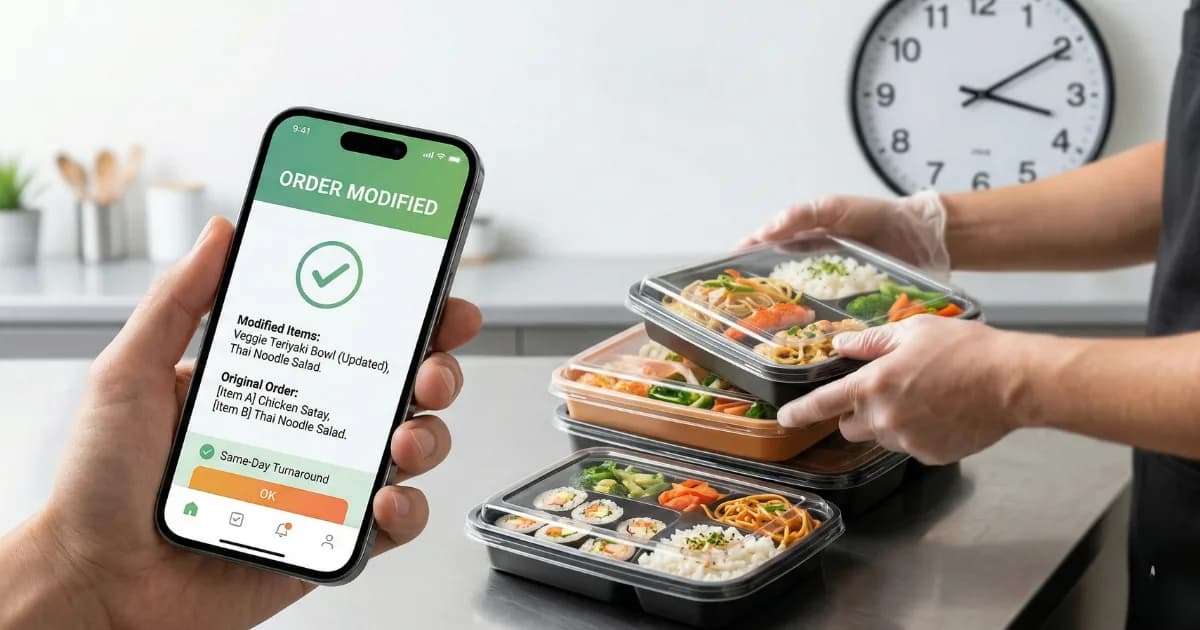
The call comes in at 8:47 AM. A kindergarten director on the phone: one child has a newly diagnosed sesame allergy as of yesterday's pediatrician visit, and that child's lunch is already in prep. Another line ringing — a parent needs to add two extra bento boxes for a playdate that materialized overnight. Meanwhile, a school administrator emails to say five additional kids are joining tomorrow's field trip, except they actually mean today's field trip, and can we handle it?
This is a normal Tuesday at Flavory Food.
Catering to families, kindergartens, and schools across Greater Vancouver means operating inside a reality where plans change constantly and the people affected are children. Rigid catering contracts designed for corporate boardrooms don't work when a four-year-old develops hives after breakfast and needs their lunch rebuilt before 11:00 AM. But running a commercial kitchen that produces hundreds of meals every morning also means we can't accommodate every change at every moment — ingredients are already sourced, prep stations are mid-flow, and delivery vehicles have departure windows dictated by Vancouver traffic.
So we built a system that balances genuine flexibility with operational honesty. This article explains exactly how it works: what you can change same-day, what needs advance notice, how our cutoff times function, and what happens when the unexpected lands on us at the worst possible moment. No marketing gloss — just how the kitchen actually runs.
Summary: Flavory Food's same-day order change policy balances real flexibility with operational constraints. Our 9:00 AM cutoff allows headcount changes, allergy accommodations, and portion adjustments for family deliveries, kindergarten catering, and school group meal boxes across Vancouver. Menu swaps and large-scale changes require 24-48 hours notice. We handle urgent safety-related changes (new allergies, dietary emergencies) regardless of timing.
Why 9:00 AM Is the Cutoff — and What It Actually Means
Every catering operation has a point of no return. For Flavory Food, that point is 9:00 AM on the day of delivery. But unlike rigid contracts that simply say "no changes after X time," our cutoff is a graduated system based on what type of change you need.
Here's the operational reality behind that number. Our kitchen team starts at 4:00 AM. By 6:30 AM, proteins are cooking, vegetables are being prepped, and rice cookers are cycling through staged batches. By 7:30 AM, the assembly line is running — meals are being plated, portioned, and labeled. By 9:00 AM, packaging is underway and delivery staging begins. The first vehicles leave for Richmond and South Vancouver routes by 10:30 AM[1].
That timeline creates natural windows of flexibility:
- Before 7:00 AM — Almost anything can change. Ingredients haven't been committed to specific orders, and the kitchen has full flexibility to adjust.
- 7:00 AM to 9:00 AM — Headcount changes (adding or removing meals), portion adjustments, and allergen substitutions are still possible. Menu swaps become difficult because ingredients are already allocated to specific dishes.
- After 9:00 AM — Meals are packaged or in final assembly. Changes at this point mean physically pulling containers off the staging line, which delays deliveries for every client on that route.
The 9:00 AM cutoff isn't arbitrary. It's the last moment we can make changes without causing a cascade that affects other families and schools waiting for their deliveries. When a parent's change request delays the Richmond route by 15 minutes, every family on that route gets their meals later — and during the 11:45 AM to 1:15 PM traffic window, 15 minutes of delay at the kitchen becomes 30 minutes of delay on the road.
Summary: The 9:00 AM cutoff is driven by kitchen production stages, not policy preference. Before 7:00 AM offers full flexibility. Between 7:00 and 9:00 AM, headcount and allergy changes remain possible but menu swaps do not. After 9:00 AM, only safety-related changes (new allergen accommodations) are guaranteed. Changes after cutoff risk delaying every client on the affected delivery route.
Headcount Changes: The Most Common Same-Day Request
Roughly 60 percent of the same-day modification requests we receive are headcount changes — adding or removing meals from an existing order. This is the change we've optimized our system to handle most efficiently, because it happens so frequently.
Adding meals (1-5 additional): If you call before 9:00 AM, we can almost always add a small number of meals to your order. Our kitchen builds a daily buffer into production — typically 5-8 percent above confirmed orders — specifically to absorb these additions. The buffer meals follow the day's standard menu, so if you're adding meals for children at a kindergarten, they'll receive whatever the rotation specifies for that day.
Adding meals (6+ additional): Larger additions before 7:00 AM are straightforward. Between 7:00 and 9:00 AM, we'll do our best, but ingredient allocation may limit what's possible. A school calling at 8:15 AM to add 12 field trip lunches will likely get them — but the menu options may be limited to whatever we have surplus ingredients for, not the full rotation.
Removing meals: Reductions are operationally simpler than additions, but they still have a financial dimension. Meals removed before 9:00 AM are credited toward your next order. Meals removed after 9:00 AM — when they're already packaged — are not credited, because the food cost has been committed. We'd rather be upfront about that than surprise you on the invoice.
The kindergarten scenario: Our five kindergarten contracts across Vancouver each have standing daily orders based on enrolled headcount. But kids get sick, go on vacation, or have schedule changes that parents communicate at the last minute. We see an average of 2-3 headcount adjustments per kindergarten per day, and our system handles these seamlessly as long as they come in before the 9:00 AM cutoff. The daycare coordinator calls or messages, the adjustment hits our order system, and the assembly line adapts.
Summary: Headcount changes are our most common same-day request at roughly 60% of all modifications. Small additions (1-5 meals) are absorbed by our daily production buffer. Larger additions work best before 7:00 AM. Reductions before 9:00 AM receive credit; after 9:00 AM they do not, because food costs are committed. Kindergarten contracts average 2-3 headcount adjustments per location per day.
Menu Changes vs. Dietary Accommodation Changes
These two categories sound similar but are operationally very different, and understanding the distinction helps explain why we handle them on different timelines.
Menu changes mean swapping one dish for a different dish — replacing teriyaki chicken with mapo tofu, for example, or switching from a noodle base to rice. These changes require different ingredients, different prep techniques, and different cooking station assignments. After 7:00 AM, when our parallel cooking stations are already running their assigned dishes, a menu swap means disrupting a station's workflow to produce something unplanned. At scale, that disruption cascades. The station that gets pulled off its planned dish falls behind, which delays assembly for every order that needs that dish.
This is why menu changes need 24 hours notice. It's not a policy designed to be inflexible — it's the minimum time our purchasing team needs to source different ingredients and our kitchen manager needs to adjust station assignments.
Dietary accommodation changes mean modifying the preparation of an existing dish to meet a dietary need — removing peanuts from a kung pao preparation, using tamari instead of soy sauce for a soy-restricted child, holding the sesame garnish. These changes work within the existing recipe framework. The base dish stays the same; we're adjusting specific components.
Because dietary accommodations don't require new ingredients or different station assignments, we can handle them much later in the production cycle. A parent calling at 8:30 AM to flag a new allergy can typically be accommodated because the core meal is already in production — we just need to modify one element during assembly.
The critical exception: new severe allergies. If a parent calls to report that their child was just diagnosed with a severe allergy — the kind that requires an EpiPen — we treat this as a safety event regardless of timing. Even after 9:00 AM, we will pull that child's meal from the packaged delivery and either rebuild it on our allergen-safe prep station or replace it with a confirmed-safe alternative. The child does not receive a meal we can't verify as safe. Period.
This is one area where we deliberately break our own cutoff rules, because a child's safety outweighs our production schedule. We've done it, and we'll keep doing it every time it's needed.
Summary: Menu changes (different dish entirely) require 24 hours notice because they affect ingredient sourcing and station assignments. Dietary accommodation changes (modifying an existing dish for allergies or restrictions) can be made same-day, typically up to and even past the 9:00 AM cutoff. Severe allergy reports are treated as safety events with no time restriction — we will pull and rebuild a child's meal regardless of production stage.
How School and Field Trip Orders Work Differently
School group meal box orders — for field trips, sports days, and end-of-term events — operate on a different flexibility framework than our standing kindergarten contracts or family delivery subscriptions. The reason is volume and logistics.
A standing kindergarten contract delivers 15-30 meals daily to the same location. We know the route, we know the headcount pattern, and small daily adjustments are built into the workflow. A field trip order for 45 meal boxes going to a park in North Vancouver is a one-time event that gets planned from scratch — different volume, different delivery location, potentially different menu, and zero historical pattern to fall back on.
What we need from schools for event orders:
Final headcount confirmed 48 hours before the event. This is the number we purchase ingredients for and build into our production plan. I can't stress this enough: a field trip order for 45 that becomes 55 the morning of the event means 10 meals that either come from our production buffer (reducing availability for other clients) or simply don't exist.
Dietary restrictions submitted with the initial order. If three children in the group have nut allergies and two are vegetarian, that information needs to be part of the order from the start — not communicated the morning of delivery when those meals are already assembled.
Delivery address and access instructions 48 hours out. Delivering to a school building with a loading dock is very different from delivering to a park shelter in Pacific Spirit Regional Park. If the delivery requires specific parking, timing around park closures, or access through a gate, we need to plan the route accordingly.
Same-day flexibility for school orders:
Even with the 48-hour confirmation, things change. Here's what we can accommodate on the day of delivery:
- Headcount increase of up to 5 meals: Usually possible from our buffer. Call before 9:00 AM.
- Headcount decrease of any size: Always possible. Credit applied to future orders.
- Individual dietary pulls: If a parent calls the school at 8:00 AM to say their child can't eat the ordered meal, we can pull it and substitute from our allergen-safe prep station as long as we hear about it before final staging.
- Delivery time adjustment (within 1 hour): If the field trip departure time shifts, we can usually adjust our delivery window by up to an hour. Larger shifts depend on route availability.
What we can't do same-day for school orders: adding 15 meals, changing the menu from bento boxes to sandwich packs, or rerouting a delivery from a Burnaby school to a North Vancouver park. Those changes require the 48-hour lead time.
Summary: School event orders (field trips, sports days) require 48-hour confirmation of headcount, dietary restrictions, and delivery details. Same-day adjustments of up to 5 additional meals, any reduction, individual dietary pulls, and minor delivery time shifts are accommodated. Large headcount increases, menu changes, and major route changes require the full 48-hour notice period.
The Operational Reality: Why Some Changes Are Harder Than They Sound
Parents and school administrators sometimes wonder why a seemingly simple change — "just add three more lunches" — can be complicated. The answer is that our kitchen operates as an interconnected system where changes in one area ripple through others. Transparency about this process helps set realistic expectations.
Ingredient sourcing is forward-committed. We purchase ingredients based on confirmed orders, typically 48 hours in advance for proteins and daily for fresh produce sourced from local Fraser Valley suppliers and Metro Vancouver wholesale markets. When we add meals same-day, those meals draw from our buffer stock. The buffer exists specifically for this purpose, but it has limits. On a day when multiple clients request additions, the buffer can get stretched thin — and we won't compromise portion sizes to fill the gap.
Station assignments are time-locked. Our kitchen runs three parallel cooking stations — protein, vegetable, and grain — each following a timed sequence that converges at the assembly line by 7:30 AM. According to commercial kitchen efficiency research, parallel processing is the primary method for achieving high-volume output within fixed time windows[2]. Asking a station to produce an unplanned item mid-sequence means either delaying that station's planned output or pulling a cook from another station, both of which create downstream problems.
Delivery routes are capacity-constrained. Three vehicles leave between 10:30 AM and 11:00 AM, each carrying meals for specific routes across Metro Vancouver — Richmond and South Vancouver first, Downtown and North Vancouver second, Burnaby, Coquitlam, and Surrey third. Adding meals to an order might seem simple from a cooking perspective, but if the delivery vehicle for that route is already at capacity, we have a logistics problem that cooking more food doesn't solve. During Vancouver's rainy season from October through April, we also need to account for slower transit times and keep delivery bags properly temperature-controlled, which limits how long we can extend a route.
Labeling and allergen tracking cannot be rushed. Every meal leaving our kitchen carries a label with complete allergen information, dish name, and preparation date[3]. When we modify an order same-day, every affected label needs to be updated. For kindergarten orders where meals carry individual child identifiers alongside allergen callouts, a last-minute headcount change means relabeling multiple containers. Our packaging lead handles this, but it takes time — time that comes directly from the staging window before vehicles depart.
I share these details not to discourage change requests, but so you understand what happens on our end when you call. Your request matters to us. We just want you to know why some changes take ten minutes to process and others take ten seconds.
Summary: Same-day changes affect four interconnected systems: ingredient allocation (buffer stock is finite), cooking station assignments (parallel processing is time-locked), delivery vehicle capacity (three routes with fixed departure times), and allergen labeling requirements (every modification requires updated labels). Understanding these constraints helps families and schools set realistic expectations for what can be accommodated and when.
Communication Channels: How to Reach Us for Changes
We've learned that the speed and clarity of communication directly determine whether a same-day change succeeds or fails. Here are the channels available, ranked by effectiveness for time-sensitive requests:
1. Direct phone call to our operations line — fastest for urgent changes.
For any change you need processed within the current production cycle, call us. A phone conversation lets us confirm the change in real time, check ingredient and route availability immediately, and tell you on the spot whether the request can be accommodated. Our operations line is staffed from 6:00 AM to 2:00 PM on production days. For allergy emergencies, this is always the right channel.
2. Text/WhatsApp message to your assigned account contact.
Kindergarten partners and regular family delivery subscribers each have an assigned contact at Flavory Food. A quick text message works well for routine changes — "add 2 meals today" or "Sophia is home sick, remove her lunch." Your contact forwards these to the kitchen in real time. For anything complex or time-sensitive, follow up with a phone call.
3. Email — best for advance notice, not same-day urgency.
Email is excellent for 24-hour and 48-hour advance changes. It creates a written record that feeds into our order management system cleanly. But for same-day requests, email is unreliable. Our kitchen team is not checking inboxes during the 5:30 AM to 10:30 AM production window. An email sent at 7:45 AM might not be read until 11:00 AM, long after the cutoff has passed.
4. Through your daycare coordinator — standard channel for kindergarten changes.
For our kindergarten contracts, the daycare coordinator is the primary communication channel. Parents notify the coordinator, and the coordinator contacts us. This works well because coordinators batch and verify requests before passing them along, reducing errors. The critical piece: coordinators need to contact us before 9:00 AM. A parent telling the coordinator at drop-off (8:30 AM) gives us 30 minutes to process the change — tight but workable. A parent mentioning it at 9:15 AM during a hallway conversation likely means that change doesn't make it into the day's delivery.
Summary: Phone is fastest for same-day changes (operations line staffed 6 AM-2 PM). Text/WhatsApp works for routine adjustments via your assigned contact. Email is best for advance notice, not same-day — kitchen staff don't check inboxes during production. Kindergarten changes flow through daycare coordinators, who should contact us before 9:00 AM.
Real Scenarios: How We've Handled Same-Day Requests
Theory is useful, but what actually happens when the phone rings? Here are composite scenarios drawn from our real operating experience across Vancouver's kindergartens, schools, and family delivery routes.
Scenario 1: Parent reports new allergy at 8:30 AM
A mother calls our operations line. Her daughter, enrolled at one of our kindergarten partner locations in East Vancouver, was at the allergist yesterday and has a confirmed sesame allergy. Today's menu includes sesame-garnished dishes. The child's lunch is currently on the assembly line.
What we did: The kitchen manager flagged the child's order immediately. The assembly team pulled her container from the line before it reached the garnish station. We prepped a replacement meal on our dedicated allergen-safe station — same protein and grain base, but with a sesame-free sauce and no sesame garnish. The replacement was labeled with updated allergen information, the child's identifier, and a "MODIFIED — new allergen restriction" flag. It was staged with the kindergarten's delivery batch and went out on time.
Total time to process: 18 minutes. No delay to other orders on the route.
Scenario 2: School adds 5 students to field trip lunch at 8:15 AM
A school administrator calls. Five additional Grade 3 students are joining the field trip, and their parents just signed the permission slips that morning. The original order was for 42 meal boxes.
What we did: Checked our production buffer — we had 7 surplus meals in the day's standard menu configuration. Pulled 5, labeled them for the school's order, and added them to the delivery batch. The administrator confirmed no new allergen restrictions among the five added students. Meals went out on schedule with the rest of the order.
Total time to process: 8 minutes. Buffer stock reduced from 7 to 2 for the remainder of the morning.
Scenario 3: Family subscriber wants to swap menu at 7:45 AM
A family delivery customer calls asking to change today's order from the mapo tofu bento to the teriyaki chicken bento. Mapo tofu is already in the wok. Teriyaki chicken is also in production, but portions are allocated to existing orders.
What we did: Explained that the teriyaki chicken is fully allocated and swapping would mean short-changing another family's order. Offered two alternatives: keep the mapo tofu (which was already being prepped to their family's usual portion spec), or receive a credit and skip today's delivery. The customer kept the mapo tofu. We noted their preference for teriyaki chicken and prioritized it in their next delivery.
Total time to process: 4 minutes. Honest conversation, no disruption to other orders.
Scenario 4: Kindergarten headcount drops by 6 at 8:50 AM
A daycare coordinator texts our account contact: six children are home with a stomach bug. The standing order is 24 meals; today they need 18.
What we did: Reduced the assembly count for their order immediately. The 6 surplus meals had already been assembled but not yet staged for delivery. We reallocated 3 to our production buffer (for potential same-day additions from other clients) and held 3 as backup in case the kindergarten's headcount shifted again before our vehicle departed at 10:40 AM. The daycare received a credit for the 6 removed meals on their next invoice.
Total time to process: 5 minutes. No route delay.
Summary: Real scenarios demonstrate the policy in practice: allergen emergencies are handled immediately regardless of timing (18-minute turnaround), small headcount additions draw from buffer stock (8 minutes), menu swaps after 7:00 AM are explained honestly with alternatives offered, and headcount reductions are credited and surplus meals are reallocated to the buffer pool.
How We Compare to Rigid Catering Contracts
Many schools and organizations that come to us have previous experience with traditional catering companies. The comparison helps illustrate why our approach works differently for the family and education market.
Traditional corporate catering contracts typically lock in menus, headcounts, and delivery details 72 hours to one week in advance. Changes within 48 hours incur fees — often 50-100 percent of the meal cost. Same-day changes are usually refused outright. This model works for a boardroom lunch where the attendee list is confirmed by an executive assistant days ahead. It does not work when you're feeding children whose parents communicate schedule changes at 8:00 AM drop-off.
Flavory Food's approach starts from the assumption that changes will happen, not that they should be penalized. We build operational buffer into every production day. We staff our kitchen to absorb moderate same-day adjustments. We use a graduated flexibility system instead of a hard wall. And critically, we never charge a penalty for allergy-related changes, because safety is not a premium service — it's a baseline.
The trade-off is real, though. Our flexibility requires the 9:00 AM cutoff and the 48-hour advance notice for large events. We build buffer stock, which means slightly higher baseline production costs that are reflected in our pricing. We can't offer the same volume discounts that high-volume corporate caterers extend, because our per-order operational overhead is higher. But for families sending their children to school with our meals, and for kindergarten directors managing 20 diet profiles that shift weekly, the flexibility isn't a feature — it's a requirement.
According to a Canadian Centre for Food Integrity survey, 75 percent of Canadian consumers consider transparency in food preparation and sourcing important when choosing food service providers[4]. Our flexibility policy is built on that same principle: tell people exactly how the system works, what it can do, what it can't, and why. Families who understand the 9:00 AM cutoff respect it. Schools that know about the 48-hour confirmation window plan around it. And when the unexpected happens — a new allergy, a last-minute headcount spike, a rainy-day route delay — we handle it because our system was designed to absorb those shocks, not break under them.
Summary: Traditional catering contracts require 72-hour to one-week advance confirmation with penalty fees for changes. Flavory Food builds flexibility into daily operations with production buffers, graduated cutoff windows, and zero penalty for allergy-related modifications. The trade-off: slightly higher baseline costs versus rigid contracts, but essential flexibility for families and kindergartens where daily changes are the norm, not the exception.
What We're Working to Improve
No system is perfect, and I want to be transparent about the areas where our flexibility policy still has friction.
Later cutoff time. We know 9:00 AM is early, especially for parents who learn about changes during school drop-off. We're evaluating whether a 9:30 AM cutoff is operationally feasible by streamlining our assembly-to-staging transition. This would require faster packaging equipment and a tighter staging protocol, both of which we're investing in.
Digital change requests. Currently, phone and text are the primary channels for same-day changes. We're building out an online ordering portal that will allow kindergarten coordinators and family subscribers to submit modifications directly into our production system, reducing the lag between a request and its arrival at the kitchen. The goal is to eliminate the "email sent at 7:45 AM but not read until 11:00 AM" problem entirely.
Larger buffer capacity. Our current 5-8 percent production buffer handles most days, but during peak periods — September enrollment surges, holiday event season, summer camp orders stacking up — the buffer gets stretched. We're working on predictive models based on historical order patterns that would allow us to scale the buffer dynamically based on the day's risk profile.
These improvements won't change the core physics of the operation — ingredients still need to be sourced, food still needs to be cooked, and delivery vehicles still need to navigate Vancouver traffic. But they'll widen the window of flexibility within those constraints, which is what families and schools have consistently told us they need.
Summary: Active improvements include evaluating a 9:30 AM cutoff (requires faster packaging equipment), building a digital portal for direct order modifications, and developing predictive buffer models for peak periods. Core operational constraints remain — sourcing, cooking, and Vancouver traffic — but the flexibility window within those constraints is being systematically widened.
Frequently Asked Questions
What is the cutoff time for making same-day changes to my order?
Our standard cutoff is 9:00 AM on the day of delivery. Before 7:00 AM, almost any change is possible — menu swaps, headcount adjustments, dietary modifications, even cancellations. Between 7:00 and 9:00 AM, we can handle headcount changes of up to 10 percent, allergen accommodations, and portion adjustments, but menu swaps are no longer feasible because ingredients are already committed to specific dishes. After 9:00 AM, only safety-related changes such as new allergy accommodations are guaranteed. For everything else, the earlier you call, the more options we have.
Can you accommodate a new food allergy reported on the morning of delivery?
Yes — always. Allergy accommodations are the one category of change where we deliberately override our cutoff rules. If a parent calls at 8:30 AM or even 9:15 AM to report a newly diagnosed allergy, we will pull that child's meal from the line and either rebuild it on our dedicated allergen-safe prep station or substitute a confirmed-safe alternative. The child will not receive a meal we cannot verify as safe. We've handled this scenario multiple times across our kindergarten contracts, and our typical turnaround for an allergy-related modification is under 20 minutes.
How do I request a same-day change to a kindergarten meal order?
The fastest channel is a phone call to our operations line, staffed from 6:00 AM to 2:00 PM. For routine changes — adding or removing a meal, noting an absence — you can also text or WhatsApp your daycare coordinator, who relays the change to our team. The critical step is ensuring the change reaches us before 9:00 AM. If a parent mentions a change at 8:30 AM drop-off, the coordinator has a 30-minute window to contact us. Email works for advance notice but is unreliable for same-day requests, as our kitchen team does not monitor inboxes during the production window.
Will I be charged for meals I cancel on the same day?
If you notify us before 9:00 AM, cancelled meals are fully credited toward your next order. After 9:00 AM, meals are already packaged and the food cost has been committed, so no credit is applied for cancellations past that point. For school event orders, the same principle applies to the confirmed headcount: reductions communicated before our cutoff receive credit, while reductions after cutoff do not. We believe in being upfront about this so there are no billing surprises.
What if I need to add more than 5 meals on the same day for a school event?
It depends on timing. Before 7:00 AM, larger additions are straightforward because we still have full ingredient flexibility. Between 7:00 and 9:00 AM, we can often accommodate additions of 6-10 meals from our daily production buffer, though menu options may be limited to what we have surplus ingredients for rather than the full rotation. After 9:00 AM, additions beyond our remaining buffer are not possible because we cannot source and cook additional ingredients within the delivery window. For school events where headcount changes are likely, we recommend building a 10 percent buffer into your initial order — we only charge for meals actually delivered.
Let Us Show You How Flexibility Works in Practice
The best way to understand Flavory Food's approach to order management is to experience it. Book a complimentary tasting session where we'll walk you through our kitchen workflow, show you how same-day changes are processed, and let you taste the meals your family, kindergarten, or school program would receive.
References
[1]: Harris Aoki, "Strategies for Designing an Efficient Kitchen Layout," 2025. Efficient kitchen workflows require reverse-scheduling from delivery departure times, with parallel station processing as the primary volume-scaling method. https://harrisaoki.com/strategies-for-designing-an-efficient-kitchen-layout/
[2]: CloudKitchens, "How to Streamline Bulk Food Production Operations," 2025. Parallel processing across dedicated cooking stations is the single largest lever for reducing total prep time in commercial kitchens. https://cloudkitchens.com/blog/strategies-to-streamline-bulk-food-production-operations/
[3]: Vancouver Coastal Health, "Food Safety," 2026. Food premises inspection and licensing requirements including labeling standards for commercial kitchens operating in the Vancouver Coastal Health region. https://www.vch.ca/en/health-topics/food-safety
[4]: Canadian Centre for Food Integrity, "2024 Public Trust Research," 2024. Survey findings on Canadian consumer attitudes toward transparency in food preparation, sourcing, and food service operations. https://www.foodintegrity.ca/research/public-trust-research/
[5]: BC Centre for Disease Control, "Food Premises Guidelines," 2026. Guidelines for safe food handling, including allergen management protocols and temperature control requirements for food service operations in British Columbia. https://www.bccdc.ca/health-professionals/professional-resources/food-premises-guidelines
Related Articles
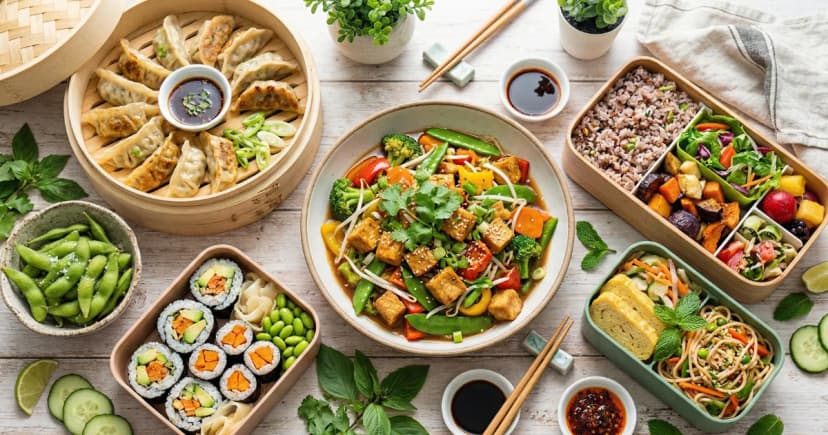
Vegetarian and Vegan Asian Meals: Our Plant-Based Menu
Explore The Storm Cafe's vegetarian and vegan Asian menu: tofu, tempeh, mushroom dishes, and veggie
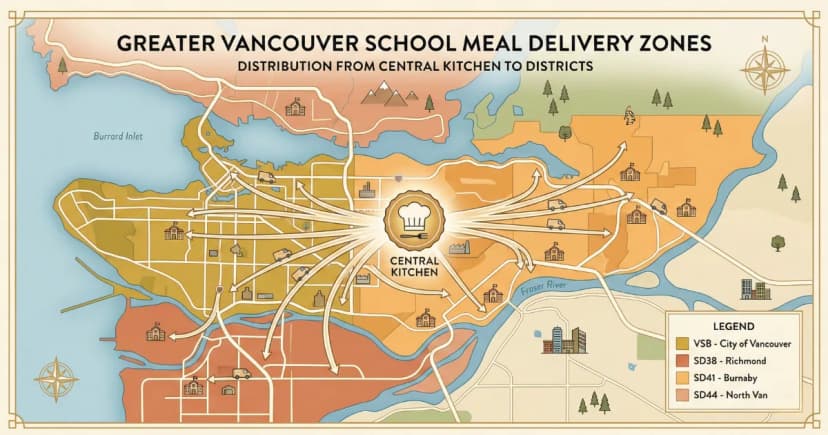
Vancouver School Lunch Delivery: Coverage Map and Zones
Flavory Food's school lunch delivery coverage across Greater Vancouver. Zone-by-zone guide with driv
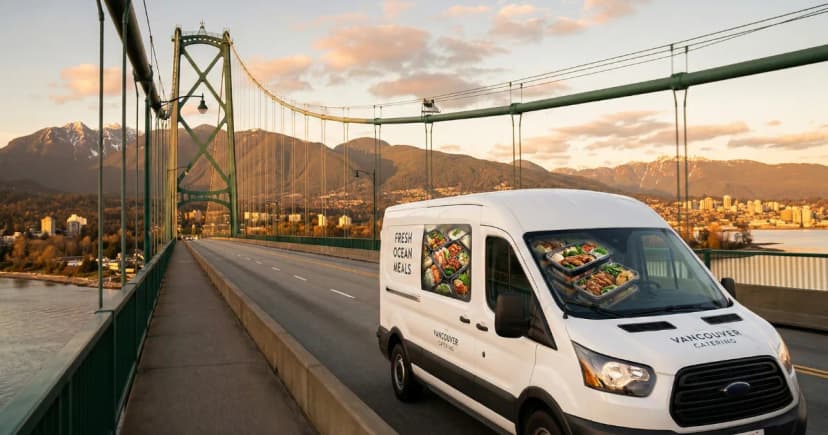
North Vancouver Meal Delivery: Crossing the Bridge for Fresh Asian Food
North Vancouver meal delivery from The Storm Cafe. Fresh Asian cuisine across Lions Gate and Ironwor
Want to taste our meals?
Book a free tasting and let our fresh ingredients speak for themselves.
Free Tasting